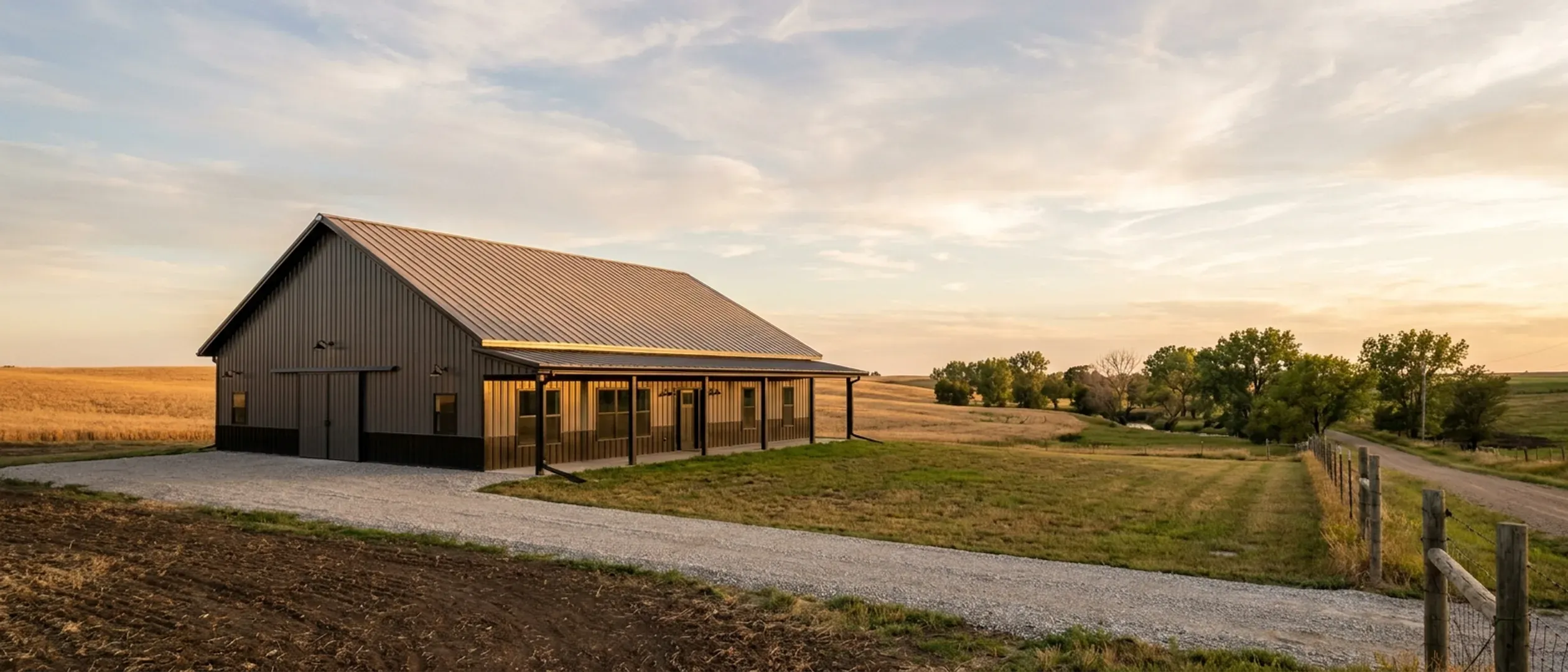
Barndominium Build Timeline in Kansas: Permits, Perc Tests, Cold Pours and Storm Season
Most timeline pages attach week counts to a list of stages and call it a schedule. This one does not, because in Kansas there is no single schedule to publish. The front end of a build depends on who regulates the parcel, and that ranges from a county with a full plan review and inspection sequence, through a county that issues a permit but has adopted no building code, to parcels where the septic permit is the only public approval involved. What can be checked are the gates themselves: the documents a county asks for before it will issue anything, the conditions under which the State's septic bulletin says a perc test is reliable, the temperatures at which one county will pass a footing inspection, the notice period before excavation, and the months when the National Weather Service records most Kansas tornadoes. Those are sourced below. The gaps between them are where your own schedule lives, and a builder who quotes you a fixed number of weeks before knowing which of these apply is guessing.
Figures on this page are cited third-party or government data, not a quote from Kansas Barndominium Builders.
Bottom Line Up Front
- The shell is fast and the interior is not. Once the pad or foundation is ready, a post-frame or steel shell goes up and dries in quickly; the insulation, mechanicals, drywall and finishes of the living quarters take most of the remaining calendar.
- The front end varies more by parcel than by building. Unincorporated Johnson County wants an address, an entrance permit, a septic or sewer permit, a site plan from a boundary survey and, for steel or post-frame homes, engineer-sealed drawings before it issues a permit; Riley County issues a permit but has adopted no building code; some rural counties issue no residential building permit at all.
- Soil and weather set hard windows. KDHE's Bulletin 4-2 says the best time for a perc test is spring when soil is normally wet, that an accurate test in cracked dry soil may not be possible, and that absorption fields should not be built when soil is too wet.
The stages, and what each one waits on
No week counts here. Each stage lists the thing it genuinely waits on, which is what you should ask about when a builder gives you a date.
1. Land due diligence
Waits on the county: zoning district, whether a building code and permit apply, who issues the septic permit, road frontage and entrance rules, and any recorded covenants. Riley County's application asks you to verify homeowner association and covenant restrictions before you apply.
2. Survey, address and entrance
Waits on a boundary survey (Johnson County requires the site plan to be drawn from one), a 911 address from the county records office, and the entrance permit from the road authority. None of these can be skipped where a permit is required, and they can run in parallel.
3. Perc test or soil evaluation, then septic permit
Waits on soil conditions (spring is best, dry cracked soil may make an accurate test impossible, per KDHE Bulletin 4-2) and on the county environmental office. Where the county has no sanitary code, the Bulletin 4-2 standards apply and variances go to KDHE.
4. Plans and, where required, sealed drawings
Waits on the kit manufacturer's engineering and, where the building department requires it, a design professional's seal. Johnson County requires sealed drawings for steel-framed and post-frame homes in its unincorporated area. Kansas licensure law itself does not require an architect or engineer for a building of no more than two dwelling units.
5. Building permit (where one exists)
Waits on the local review queue and on a complete application. A review clock only starts when every required document is in.
6. Dig notice, then site work
Waits two full working days after notice of intent to excavate, and not more than 20 calendar days (K.S.A. 66-1804), so buried utilities can be marked. Then pad, drive and trenching, kept off the marked septic area.
7. Footings or posts, then slab
Waits on inspection where one applies (Johnson County requires two hours' notice for same-day concrete inspections) and on weather. Cold-weather pours need protection on site.
8. Shell and dry-in
Waits on the package arriving and on the crew. This is the stage that goes quickly. Getting to dry-in before a spring storm window is worth resequencing for.
9. Rough-ins, insulation, drywall
Waits on the trades. Licensed trade contractors handle plumbing, electrical and HVAC, and in jurisdictions that inspect, each rough-in is inspected before it is covered; Johnson County's list runs through rough-in, insulation and drywall inspections.
10. Finishes, septic final, move-in
Waits on finish trades and, where permits apply, on the final. Johnson County will not schedule a final building inspection until the septic and entrance final reports have been received from Environmental and Public Works.
What makes a Kansas schedule longer
These are the delays with a documented cause. Plan for the ones that apply to your parcel.
Soils that limit a conventional field
Bulletin 4-2 notes that many soils, especially in eastern Kansas, restrict their suitability for soil absorption fields, and that lagoons or alternative treatment systems may be used instead. A design change, and a variance where one is needed, adds steps.
Sealed-drawing requirements
Where the building department wants engineer-sealed drawings for a post-frame or steel home, the design has to be finished and stamped before the permit review can begin.
Relying on an agricultural exemption that does not apply
Douglas County, for example, requires Schedule F farm income, at least three acres in agricultural use and a site plan before it grants an agricultural determination, and its affidavit defines an agricultural building as one that is not a place of human habitation. Starting a house as if it were exempt, and then being told it is not, costs more time than applying correctly at the outset. Riley County doubles the permit fee if construction begins before the permit is issued.
Winter foundations
Where pours need protection and heat, as Johnson County's cold-weather rule requires for inspection, each pour takes longer to prepare and protect.
What makes it shorter
Some genuine advantages of the building type and of rural Kansas, stated without inventing numbers.
A kit arrives as a package
Frame, sheeting and trim arrive together from one manufacturer with its own engineering, so the shell does not wait on many separate suppliers.
No plan review queue in some counties
Where no building code is adopted, the permit, if there is one, checks zoning and sanitary compliance only. That removes a review step, though it also removes the independent check of the structure.
Front-end steps can overlap
Survey, address, entrance permit and soil evaluation are different offices and can proceed at the same time, if someone is managing all of them.
Reading this because you are weighing a build? The next step is a plan drawn for your program.
What's different about Kansas
Who regulates the parcel decides the length of the front end
Kansas has no statewide residential building code; the Kansas Corporation Commission describes code adoption and enforcement as the responsibility of local jurisdictions. That produces three different front ends. In unincorporated Johnson County, which adopted the 2018 International Codes effective 1 July 2020, plans are uploaded with the application and reviewed, and an inspection will not be done without approved plans on the job site. In Riley County a permit is required for any structure but the county states it has not adopted building codes, so the permit checks zoning, setbacks and sanitary code compliance rather than framing. And where a county issues no residential building permit, the septic permit, an entrance permit and the utility's own requirements are the public approvals. Find out which you are in before you build a calendar.
Paperwork that must exist before a permit can
Johnson County's new-dwelling permit page is a useful checklist of lead items even outside the county. No permit will be issued without an address from the county's records office. An entrance (driveway) permit comes from Public Works if this is the first structure on the property. A septic or sewer permit comes first if the house has plumbing. The site plan must be drawn in accordance with an accurate boundary line survey. And steel-framed and post-frame homes require drawings designed and sealed by a licensed design professional, including a sealed truss package where pre-engineered trusses are used. Each is its own queue, with its own office.
The septic test has a season
KDHE Bulletin 4-2 describes the perc test as four to six holes at the depth of the proposed laterals, soaked until the clay is swelled, usually for at least 24 hours, before the rate is measured. It says the optimum time to conduct a perc test is in the spring when the soil is normally wet, and that an accurate perc test during a dry period when the soil is cracked may not be possible. Some county codes also require a soil profile evaluation. A buyer who closes on land in a dry late summer may be waiting on soil conditions, not on paperwork.
Wet soil stops the septic field, not just the test
The same bulletin warns that building a septic tank and lateral field when the soil is too wet causes compaction and smearing that greatly reduces absorption, and gives a field test: if the soil can be rolled into a wire a quarter of an inch thick without falling apart, construction should not proceed. It also says heavy equipment and loaded trucks should be kept off the marked absorption area, which matters on a site where a slab, a drive and a septic field are all being built in the same season.
Cold-weather concrete rules are local, and specific
Kansas sets no statewide frost depth; figures come from the jurisdiction. Johnson County publishes its cold-weather concreting rule for inspections: 20 to 22 degrees Fahrenheit and rising to pour footings, 30 degrees and rising to pour walls, and weather protection on site whenever the air is below 40 degrees or forecast to fall below it in the next 24 hours, or the inspection fails. Blankets, straw and tented plastic with heat are listed as acceptable protection. Even where no inspector enforces a rule like this, the concrete behaves the same way, so a winter foundation carries protection time and cost.
Spring is tornado season, and it overlaps the building season
The National Weather Service office in Wichita reports that April through June historically accounts for about 74 percent of annual Kansas tornadoes, with a peak from mid to late April to mid June, and that Kansas averaged 81 tornadoes a year from 1994 to 2023. For a schedule the practical effect is not the tornado itself but the storm days around it: an open shell with sheets not yet fastened, trusses not yet braced, or a pour scheduled into a line of storms. Sequence dry-in so the building is not left partly sheeted through a spring storm window.
Pros and cons, honestly
Pros
- The shell is genuinely fast. Once the pad or foundation is ready and the package is on site, a post-frame or steel structure goes up and dries in quickly.
- Clear-span framing means interior walls are not structural, so interior work does not wait on bearing walls.
- In counties without an adopted building code there is no plan review queue.
- Kansas law requires no architect or engineer for a building of no more than two dwelling units, where the local department does not ask for a seal.
Cons
- The interior of the living quarters is most of the calendar and little of the visible progress.
- The septic perc test depends on soil moisture; KDHE says an accurate test in dry cracked soil may not be possible.
- Wet soil stops septic field construction altogether until it dries.
- Cold-weather pours need protection, and in Johnson County an inspection fails without it.
- Spring, the natural start of a building season, is also the peak of the Kansas tornado season according to the National Weather Service.
How long does it take to build a barndominium in Kansas?
Can I build a barndominium in winter in Kansas?
When should a perc test be scheduled in Kansas?
Does a county with no building code make the build faster?
Do I have to wait before digging?
What is the longest single wait on a rural Kansas build?
Should I avoid building in spring because of tornadoes?
Questions answered? Tell us what you want to build and we will put real numbers against it.
Sources
- Kansas Corporation Commission — Kansas building energy codes (home rule statement)
- Johnson County — Code of Regulations for Buildings and Construction, cold weather concreting
- Johnson County — new single-family dwellings permit: required documents and inspections
- Riley County Building Division — permits and fees
- Riley County — application for permit to build, residential dwelling, modular or shouse
- KDHE Bulletin 4-2 — minimum standards for onsite wastewater systems (perc test, wet-soil construction)
- K.A.R. 28-5 — sewage and excreta disposal (KDHE)
- Douglas County — agricultural exemption packet and affidavit
- K.S.A. 66-1804 — notice of intent to excavate
- K.S.A. 74-7031 — architecture exemptions (two dwelling units)
- National Weather Service, Wichita — Kansas tornado climatology and statistics
- National Weather Service, Wichita — historical Kansas tornado statistics
Keep reading
The pages that answer the next question this one raises.
Are barndominiums legal in Kansas?
Which codes, permits and septic rules reach your parcel: the rules that decide the front end of this schedule.
Read itSite preparation
Pad, drive and trenching, planned around the septic field and the dig-notice window.
Read itPermitting help
Assembling the survey, address, entrance, septic and building permit steps in parallel.
Read itTurnkey builds
One team managing every stage on this page, from land checks to move-in.
Read itStart the survey
Tell us about your land and timing, and we will map which gates apply to it.
Read itWant a real number instead of a range?
Start the survey and tell us about your land and what you want to build. Include the county and parcel ID if you have them, because in Kansas the jurisdiction, the soil and the well and septic answers change the budget more than the building does. The survey costs nothing.