Barndominium Site Prep and Foundations in Kansas
Site preparation is the work between buying the land and pouring the foundation: the road entrance, the drive, clearing, the building pad, the utility trenches and the footings. On Kansas land it is the part of the budget most likely to surprise you, because the ground changes so much across the state. The Kansas Geological Survey calls expansive clay a pervasive problem in the state; in the Flint Hills, GeoKansas notes you do not have to dig deep to reach solid rock; out on the High Plains the land is flat and the water comes from the Ogallala aquifer. We look at what is actually under your site before the pad is built.
Site Preparation: how the work runs
Four stages, in this order. The sequence matters more than it looks: settling who has jurisdiction, the septic answer and any permits before anything is fabricated is what keeps a Kansas build from stalling.
Site walk and access
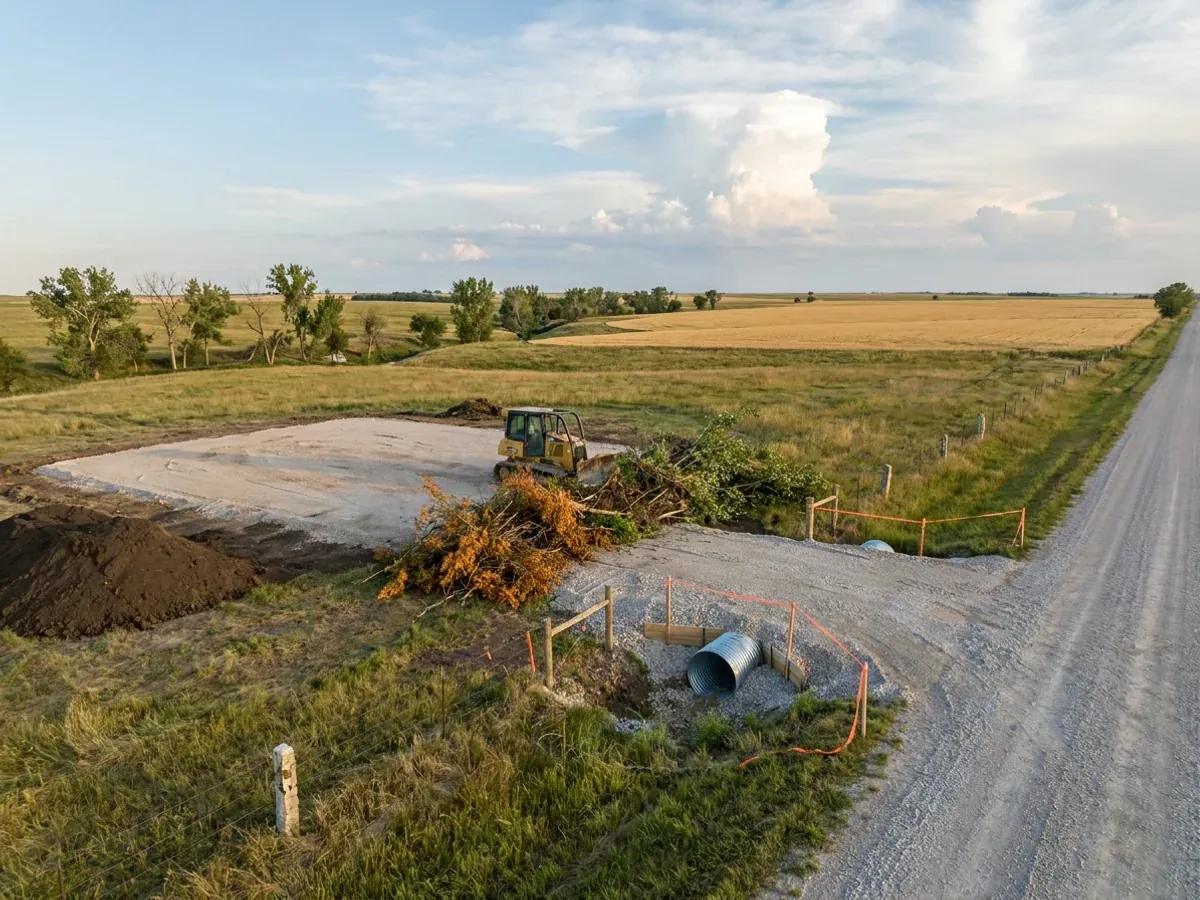
We walk the land with you: where the building, drive, septic field and well can go, how water moves across the site, and how trucks will get in. The county road entrance comes first. Franklin County, for example, requires permission from its Public Works Department before any entrance is established, and restricts building permits for non-agricultural buildings reached from a minimum maintenance road unless the owner agrees to upgrade the road.
Layout, and the licensed land surveyor
The building, septic field and well are laid out together, because each constrains the others: KDHE's septic standards keep the system at least 50 feet from a private well, and some counties ask for more. Where corners or boundaries are uncertain, a licensed land surveyor locates them before anything is dug.
Clearing, drive and building pad
Topsoil is stripped, the drive is built to carry a loaded delivery truck, and the pad is brought to grade and compacted. On clay, moisture control matters: Johnson County's building officials warn that foundations and slabs placed on dried, shrinking clay may crack and heave once the soil returns to normal moisture. We build to the grading your jurisdiction approves and keep water moving away from the building.
Footings and utilities
Footings go below the frost depth your city or county sets — there is no statewide figure — and utility trenches for power, water and the septic line are cut and bedded. Then the foundation is ready to pour.
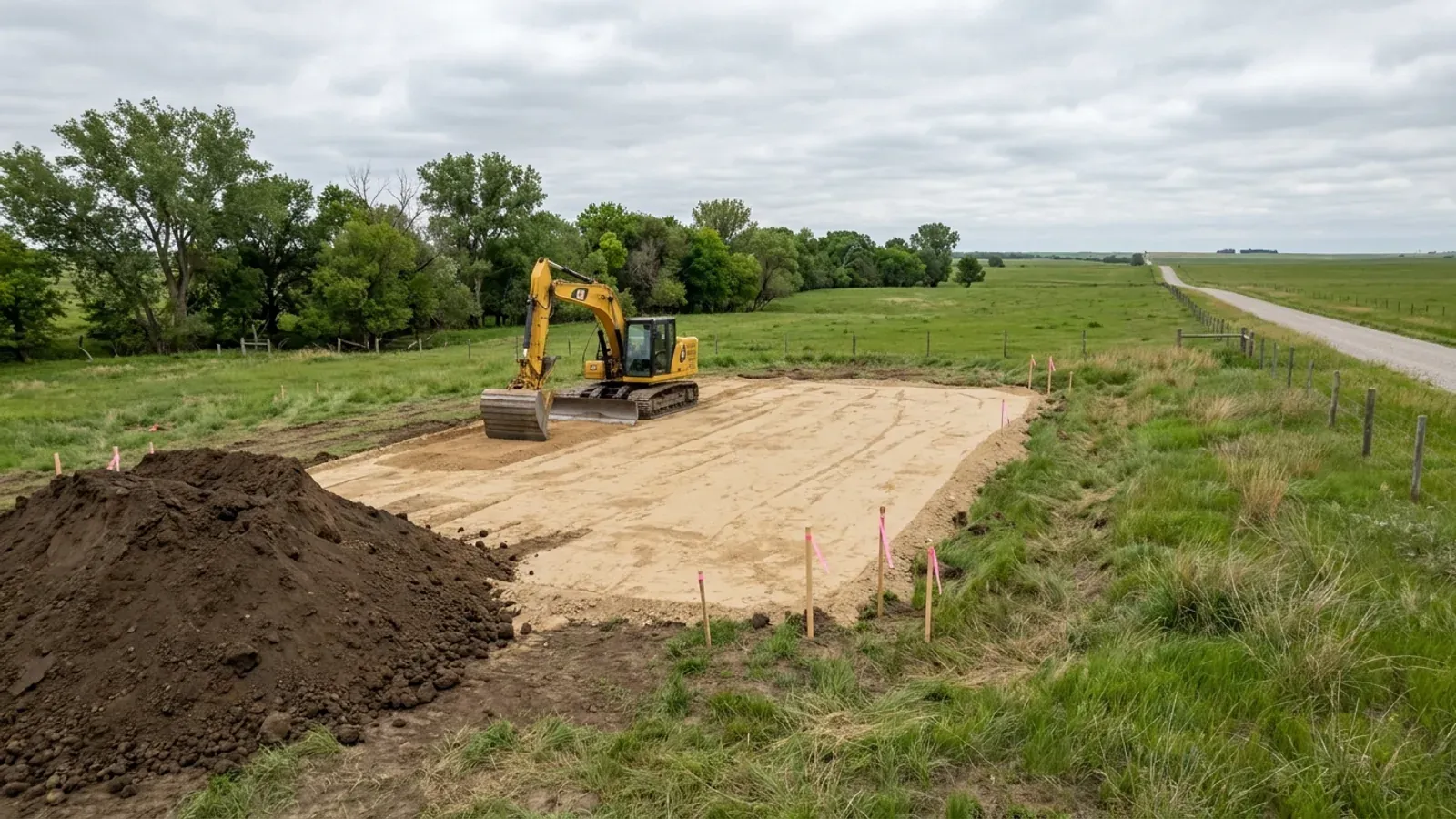
Clay in one county, rock in the next — Kansas ground decides the site budget
The Kansas Geological Survey describes expansive soils as common where clay deposits lie under the ground, heaving and shrinking from season to season and cracking foundations, driveways and sidewalks. The Flint Hills are the opposite problem: cherty, thin soil over limestone, where rock can stop an excavator well short of frost depth. And KDHE's septic standards need four feet of aerated soil below the absorption field. We check what your site actually has before the pad is priced.
Where we deliver site preparation
In Kansas the line that matters can be a city limit or a county line. Inside a city you usually have city zoning and a city building department; just outside one, a city can extend its building code with its subdivision or zoning regulations; out in the county, some counties enforce an adopted code and some issue no residential building permit at all. Cross one of those lines and what changes is whether the build is inspected, who reviews the drawings, how the land is zoned and whose snow, wind and frost values the drawings answer to. The septic permit, under the county sanitary code or the state minimum standards, goes with you everywhere.
Barndominium builders across Kansas.
Every city and county we build in has its own answer on permits, septic and design values. The service area pages set out what each one publishes.
What actually decides the price
Square footage is the number everyone leads with, and it is rarely the one that moves a barndominium budget. These four do.
-
Access, entrance and drive length
A long drive, a new county road entrance or culvert, or a road that has to be upgraded before a permit is issued can cost more than the pad itself. It is the first thing we price.
-
Soil: clay, fill or rock
Expansive clay may need moisture control, over-excavation or a different footing design. Fill under the footprint or rock under part of it are among the conditions Johnson County's building officials list as calling for a soils test or an engineer's input. Rock can mean breaking or drilling to reach depth.
-
Drainage and water
Water has to move away from the building and the septic field. Low spots, flood plain and seasonal wet areas change where the building can go and how much fill is needed.
-
Distance to power and water
A long run to the power line, a deep well, or no rural water line nearby all add cost. We find out before you commit to a building location.
Site Preparation in Kansas: common questions
8 questions we get asked most often about building in Kansas. If yours is not on the list, ask it directly.
What does barndominium site preparation include?
Is expansive clay a problem for barndominiums in Kansas?
What if I hit rock?
Do I need a survey?
How far does the septic field need to be from the house and well?
Do I need a permit for a new driveway entrance?
Can I build on land in a flood plain?
When should site work start?
Sources
- The GeoRecord, vol. 7.3 (2001), geologic hazards in Kansas — Kansas Geological Survey
- Flint Hills — GeoKansas, Kansas Geological Survey
- High Plains — GeoKansas, Kansas Geological Survey
- Residential Foundation Guideline (2020) — Johnson County Building Officials Association
- Building Department Requirements and Permits — Franklin County, Kansas
- Bulletin 4-2, Minimum Standards for Design and Construction of Onsite Wastewater Systems — Kansas Department of Health and Environment
- Private Wells: Safe Location and Construction (WMS 20-970) — Kansas Department of Health and Environment
- K.S.A. 19-2921, county zoning and agricultural land — Kansas Office of Revisor of Statutes
Keep reading
The pages that answer the next question this one raises.
Ready to put site preparation against a real plan? Start there and the rest follows.
Tell us about the land
Tell us where the parcel is and what you want on it, and we will come back with who has jurisdiction, what the land needs before it can be built on, and a realistic budget range. Starting the survey costs nothing.