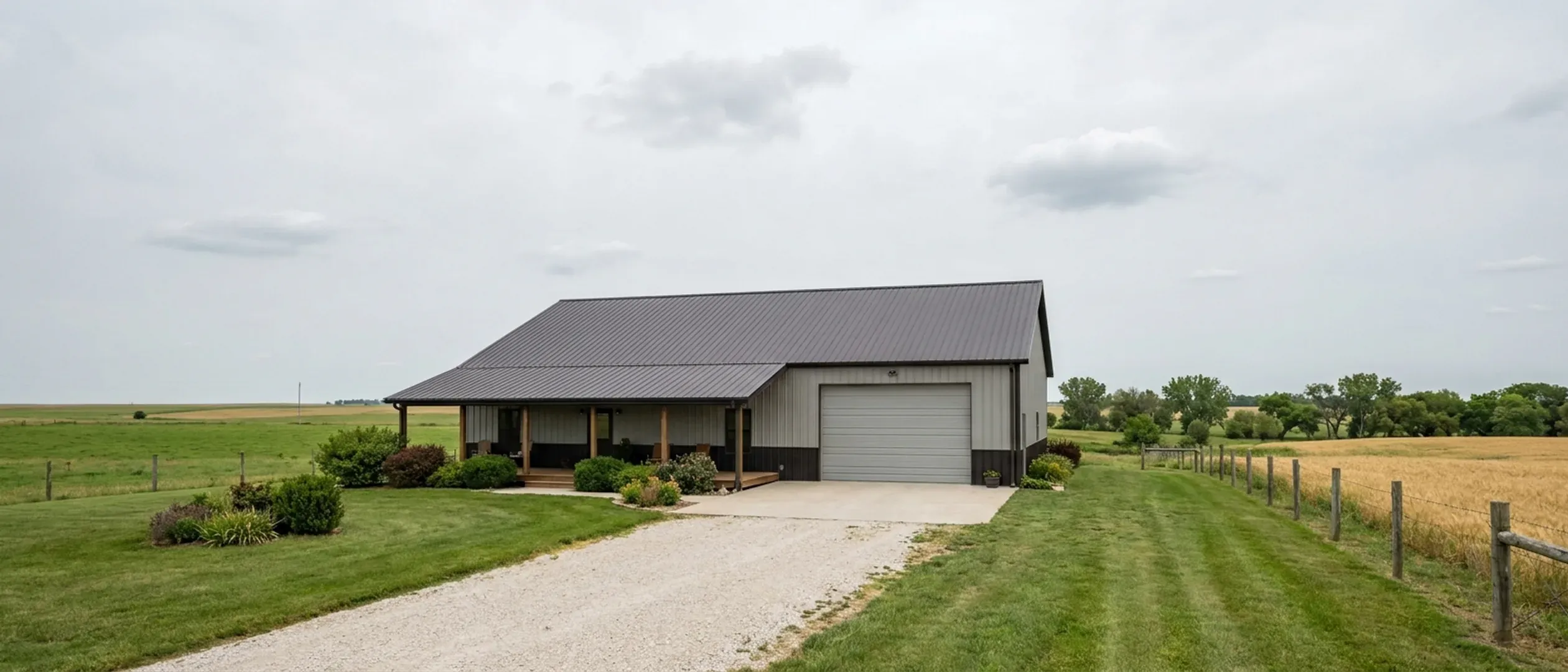
Cost to Build a Barndominium in Kansas: The Published Numbers, Sourced
Nobody measures what a barndominium costs to build in Kansas, and any page that gives you a single statewide price per square foot is guessing. What does exist is better than a guess. The Census Bureau measures what owners pay contractors to build a house on the owner's own land, and it reports the Midwest, which includes Kansas, separately. USDA publishes what an acre of Kansas cropland and pasture is worth. Kansas counties and rural water districts publish their permit and hookup fees. This guide puts those figures side by side, every one with its source, and shows which part of the budget a steel or post-frame shell actually changes. None of it is our pricing, and none of it is a quote.
Figures below are industry data from cited third-party sources, not a quote from Kansas Barndominium Builders. Every project is priced individually.
Bottom Line Up Front
- The closest published benchmark is the Census Bureau's 2025 figure for contractor-built houses on the owner's own land in the Midwest: a median contract price of $194.09 per square foot and an average of $202.13, with the land excluded. The Census median whole-house contract price in that series was $457,200.
- USDA's July 2026 Land Values survey puts Kansas non-irrigated cropland at $3,450 an acre, irrigated cropland at $4,600 and pasture at $2,400, so the land is a separate line and it varies more by region than by county line.
- Off the city grid, the ground work carries its own fees: Johnson County charges $475 for a soil profile analysis and $480 for a new-home septic permit, and Butler County Rural Water District No. 5 lists a $4,016 benefit unit plus an impact fee that rises with living space.
Published cost figures
Third-party and government figures, each with its source. None of them is a quote, and none of them is ours.
| Measure | Range | Source |
|---|---|---|
| Contractor-built houses on the owner's land, Midwest, started in 2025: median to average contract price (land excluded) | $194–$202 per sq ft | U.S. Census Bureau, Characteristics of New Housing 2025, Median and Average Contract Price per Square Foot of New Contractor-Built Single-Family Houses Started: Midwest median $194.09, average $202.13 (read 26 Sep 2026) — https://www.census.gov/construction/chars/xls/contractpricesqft_cust.xls |
| Detached new houses sold by builders, Midwest, 2025: median to average sales price (lot excluded) | $160–$170 per sq ft | U.S. Census Bureau, Characteristics of New Housing 2025, Median and Average Price per Square Foot of Floor Area in Detached New Single-Family Houses Sold: Midwest median $160.00, average $169.78 (read 26 Sep 2026) — https://www.census.gov/construction/chars/xls/soldpricesqft_cust.xls |
| Average construction cost alone (no lot, overhead, marketing or profit), national builder survey, 2024 | $162 per sq ft | NAHB, Cost of Constructing a Home 2024 (Eric Lynch, 20 Jan 2025): average construction cost $428,215, about $162 per square foot (read 26 Sep 2026) — https://www.nahb.org/news-and-economics/housing-economics-plus/special-studies/special-studies-pages/cost-of-constructing-a-home-in-2024 |
| Kansas agricultural land, 2026 state average: pasture to irrigated cropland | $2,400–$4,600 per acre | USDA NASS, Land Values 2026 Summary (released 31 Jul 2026): Kansas pasture $2,400, non-irrigated cropland $3,450, irrigated cropland $4,600 per acre (read 26 Sep 2026) — https://www.nass.usda.gov/Publications/Todays_Reports/reports/land0726.pdf |
Total cost by size
Rough totals at common sizes. These move with everything on this page, so treat them as a starting orientation, not an estimate for your project.
1,500 sq ft
$291,000–$303,000
Arithmetic, rounded to the nearest $1,000: 1,500 sq ft × the Census 2025 Midwest contract price per sq ft for contractor-built houses ($194.09 median, $202.13 average), land excluded — https://www.census.gov/construction/chars/xls/contractpricesqft_cust.xls
2,000 sq ft
$388,000–$404,000
Arithmetic, rounded to the nearest $1,000: 2,000 sq ft × the Census 2025 Midwest contract price per sq ft for contractor-built houses ($194.09 median, $202.13 average), land excluded — https://www.census.gov/construction/chars/xls/contractpricesqft_cust.xls
2,400 sq ft
$466,000–$485,000
Arithmetic, rounded to the nearest $1,000: 2,400 sq ft (a 40x60 footprint) × the Census 2025 Midwest contract price per sq ft for contractor-built houses ($194.09 median, $202.13 average), land excluded — https://www.census.gov/construction/chars/xls/contractpricesqft_cust.xls
3,000 sq ft
$582,000–$606,000
Arithmetic, rounded to the nearest $1,000: 3,000 sq ft × the Census 2025 Midwest contract price per sq ft for contractor-built houses ($194.09 median, $202.13 average), land excluded — https://www.census.gov/construction/chars/xls/contractpricesqft_cust.xls
What actually moves the number
The finish schedule, not the frame
NAHB's 2024 survey puts interior finishes at 24.1% of construction cost and the plumbing, electrical and HVAC rough-ins at another 19.2%. A barndominium needs the same cabinets, fixtures, drywall and mechanical systems as any house, so the finishes you pick move the total more than whether the walls hang on steel or on posts.
Septic and well, where there is no main
Two in three contractor-built homes completed in the Midwest in 2025 were on their own septic system, and 57% had both a septic system and their own well, according to the Census Bureau. In Kansas the county, or KDHE where a county has no sanitary code, permits the septic system, and a licensed water-well contractor drills the well.
Foundation and ground work
NAHB puts foundations at 10.5% of construction cost and site work at 7.6%. On a rural Kansas parcel the second number is the one that surprises people: the driveway, the pad, the trenching to the power line and the water line all happen before the building exists.
Where in Kansas the land is
USDA's 2026 averages are statewide, and the spread underneath them is wide. K-State's 2025 land values book reports that the Northeast region has the highest prices per acre and the Southwest the lowest, so the same acreage can cost a very different amount near Lawrence than near Garden City.
Why the Census contractor-built figure is the one to start with
Most cost-per-square-foot numbers online are national, unsourced, or describe tract houses on finished subdivision lots. The Census Bureau's contractor-built series avoids all three problems.
It measures houses built on the owner's own land
The Census Bureau's Survey of Construction separates houses a builder puts up to sell from houses a contractor builds for an owner on land the owner already has. That second group is how nearly every barndominium gets built, and its contract price leaves the land out, so you can add your own land cost on top without counting it twice.
It reports the Midwest, and Kansas is in it
The Census Bureau reports four regions, not states. For contractor-built houses started in 2025 the Census Bureau reports a Midwest median contract price of $194.09 per square foot and an average of $202.13. The Census median whole-house contract price was $457,200 and the average $546,100, again excluding land.
Custom homes cost more per foot than houses built to sell
Detached new houses sold by builders in the Midwest in 2025 came in at a median of $160.00 per square foot and an average of $169.78, lot excluded, according to the same Census survey. The gap between that and the contractor-built figure is the price of one-off design, a single build instead of a subdivision's volume, and a rural site.
The size in the survey is close to a barndominium's
Contractor-built houses completed in the Midwest in 2025 had a median of 2,289 square feet and an average of 2,471, according to the Census Bureau. A 40x60 barndominium with all of it finished is 2,400 square feet, so the per-foot figures describe a house of about the size many Kansas buyers are pricing.
Where the money in a house actually goes
NAHB's 2024 Cost of Constructing a Home survey breaks the average construction cost of $428,215 into eight stages. It is a national figure, but it shows which parts of the budget a barndominium shell can change and which it cannot.
The part the shell replaces
Framing was 16.6% of construction cost in NAHB's 2024 survey and exterior finishes (wall finish, roofing, windows and doors) another 13.4%. A steel or post-frame shell with metal siding and roofing replaces most of those two lines. That is roughly 30% of the budget, not all of it.
The part that stays the same
Interior finishes (24.1%) and mechanical rough-ins (19.2%) together were more than 43% of NAHB's average construction cost. Kitchens, bathrooms, flooring, drywall, wiring, plumbing and HVAC cost what they cost whatever holds the roof up.
The part the land decides
Foundations (10.5%) and site work (7.6%) depend on the soil, the slope and how far the building sits from the road and the utilities. On a rural Kansas parcel, site work also includes the septic system and well that a subdivision lot would not need.
Permits and fees are a small line
NAHB's survey averages building permit fees at $7,640, or 1.8% of construction cost, with impact fees and water and sewer fees on top. The Kansas examples in this guide show why that line varies: it is set by the city, county or water district, and some rural Kansas counties issue no residential building permit at all.
Land: what USDA and K-State say an acre is worth
A barndominium budget in Kansas usually starts with land, and the land market is published.
USDA's 2026 Kansas averages
USDA's National Agricultural Statistics Service puts the average value of Kansas farm real estate at $3,200 an acre in 2026, up 3.2% from 2025. By land type, USDA reports non-irrigated cropland at $3,450 an acre, irrigated cropland at $4,600 and pasture at $2,400.
The regional spread is large
K-State's 2025 Kansas Agricultural Land Values and Trends book, built from sales reported through county courthouses, finds the highest prices per acre in the Northeast region and the lowest in the Southwest. A statewide average is a starting point, not a price for a particular parcel.
Farmland averages are not homesite prices
Both surveys measure agricultural land sold in agricultural-size parcels. A small tract split off for a house near Wichita, Topeka or the Kansas City suburbs usually sells for more per acre than the farmland average, because it is priced as a homesite.
Road frontage and utilities change the value
K-State's land values book notes that it made no adjustment for water availability, location or other parcel features. Those are exactly the features that decide what a homesite costs to develop, so budget for them separately rather than assuming the per-acre average covers them.
The rural site costs that Kansas rules and districts set
These are real published fees from Kansas authorities, used as examples. Your parcel's county, city and water district set yours.
Soil test and septic permit
Johnson County's 2026 forms charge $475 for a soil profile analysis and $480 for a permit to install a septic system for a new home. That is the county's fee alone; the system itself is designed and installed by others and priced separately.
Well permit
Johnson County's 2026 application to build a private water well carries a $65 fee. KDHE licenses the contractors who drill wells statewide, and KDHE's own guidance says the state does not regulate the water quality of a private well, so testing the water is the owner's job.
Rural water hookup
Where a rural water district reaches the parcel, joining it replaces the well. Butler County Rural Water District No. 5 lists a $4,016 benefit unit fee for a standard meter plus a one-time impact fee that is $2,210 under 2,000 square feet of living space and $4,420 from 2,000 to 2,999.
Building permit
On Johnson County's residential fee schedule, a house valued at $400,000 would carry a permit fee of $2,395 ($895 for the first $100,000 plus $5 for each further $1,000), plus the $100 plan review the county lists for a new single-family home. Many rural Kansas counties charge nothing because they issue no residential building permit; the county's zoning office will tell you which applies.
Reading this because you are weighing a build? The next step is a plan drawn for your program.
What's different about Kansas
Labor on a new home is not taxed as an installation service
K.S.A. 79-3603(p) taxes the service of installing property but excludes installation work done in the original construction of a residence. Tell your builder you expect the contract to reflect that. The exemption covers the installing labor, not the materials the contractor buys.
Septic sizing is set by bedrooms, not square footage
Where a county has no sanitary code of its own, KDHE Bulletin 4-2 applies: design flow is 150 gallons per day per bedroom and the minimum septic tank is 1,000 gallons or twice the daily flow, whichever is larger. A county code can be stricter. Adding a bedroom to the plan can enlarge the system; adding shop space does not, because the bulletin does not allow shop wastewater into a home's absorption field.
Permit fees are set by whoever issues the permit
There is no Kansas fee schedule for a house permit. Johnson County's residential fee chart, for example, charges $895 for the first $100,000 of building valuation plus $5 for each additional $1,000 up to $500,000, and its building codes page lists a $100 plan review for a new single-family home. A city, or a county with no residential permit at all, will look nothing like that.
Rural water is bought by the benefit unit
Rural water districts charge a one-time fee to join. Butler County Rural Water District No. 5 lists $4,016 for a standard 5/8 x 3/4 inch meter, tap included, plus an impact fee of $4,420 for a home of 2,000 to 2,999 square feet of living space. Road crossings and main extensions are extra and priced by bid. Every district sets its own schedule.
What is the average cost to build a barndominium in Kansas?
Is a barndominium cheaper to build than a regular house in Kansas?
What does an acre of land cost in Kansas?
How much does a septic permit cost in Kansas?
Do I pay sales tax on the labor to build a new house in Kansas?
Does a big shop make the septic system bigger?
Can you give me a price for my project?
Why does this guide use Midwest figures instead of Kansas figures?
Questions answered? Tell us what you want to build and we will put real numbers against it.
Sources
- U.S. Census Bureau — Median and Average Contract Price per Square Foot of New Contractor-Built Single-Family Houses Started (Characteristics of New Housing, 2025) — Midwest 2025: median $194.09, average $202.13 per sq ft, lot excluded. Read 26 Sep 2026.
- U.S. Census Bureau — Median and Average Contract Price of New Contractor-Built Single-Family Houses Started — Midwest 2025: median $457,200, average $546,100. Read 26 Sep 2026.
- U.S. Census Bureau — Median and Average Price per Square Foot of Floor Area in New Single-Family Houses Sold — Detached, Midwest 2025: median $160.00, average $169.78. Read 26 Sep 2026.
- U.S. Census Bureau — Square Feet of Floor Area in New Single-Family Houses Completed — Contractor-built, Midwest 2025: median 2,289 sq ft, average 2,471. Read 26 Sep 2026.
- U.S. Census Bureau — Type of Sewage System by Water Supply Source in New Single-Family Houses Completed — Contractor-built, Midwest 2025: 66% individual sewage system; 57% individual sewage and individual water. Read 26 Sep 2026.
- NAHB — Cost of Constructing a Home 2024 (Eric Lynch, 20 Jan 2025) — Average construction cost $428,215 (about $162/sq ft); stage shares and permit fees from Table 3. Read 26 Sep 2026.
- USDA National Agricultural Statistics Service — Land Values 2026 Summary (July 2026) — Kansas 2026: farm real estate $3,200, all cropland $3,540, irrigated $4,600, non-irrigated $3,450, pasture $2,400 per acre. Read 26 Sep 2026.
- K-State Agricultural Economics and KSFMRA — Kansas Agricultural Land Values and Trends 2025 — Regional sales-based values; Northeast highest, Southwest lowest price per acre. Read 26 Sep 2026.
- Johnson County Environmental Division — 2026 Application for Permit to Install a New Private Sewage Treatment System — New construction (new home build): $480. Read 26 Sep 2026.
- Johnson County Environmental Division — 2026 Application for Soil Profile Analysis — $475. Read 26 Sep 2026.
- Johnson County Environmental Division — 2026 Installation Permit Application for Construction of a Private Water Well — $65. Read 26 Sep 2026.
- Johnson County Building Codes — Building Permit Fee Chart — Plan review $100 for new single-family dwellings; valuation-based residential schedule in the linked fee chart. Read 26 Sep 2026.
- Johnson County Building Codes — Residential Building Permit Fee Chart (spreadsheet) — $895 for the first $100,000 of valuation plus $5 per additional $1,000 to $500,000. Read 26 Sep 2026.
- Butler County Rural Water District No. 5 — Meter Connection Fees — 5/8 x 3/4 inch meter benefit unit $4,016, tapping included; road crossings by bid. Read 26 Sep 2026.
- Butler County Rural Water District No. 5 — Impact Fees — One-time impact fee by living space: $2,210 under 2,000 sq ft, $4,420 for 2,000–2,999 sq ft (page updated 13 May 2024). Read 26 Sep 2026.
- KDHE Bulletin 4-2 — Minimum Standards for Design and Construction of Onsite Wastewater Systems — 150 gpd per bedroom; 1,000-gallon minimum tank; no shop wastewater to an absorption system. Read 26 Sep 2026.
- KDHE — Private Wells: Safe Location and Construction — The state does not regulate private well water quality; well contractors are licensed. Read 26 Sep 2026.
- Kansas Statutes — K.S.A. 79-3603 (retailers' sales tax), subsection (p) — Installation services in the original construction of a residence are not taxed. Read 26 Sep 2026.
Keep reading
The pages that answer the next question this one raises.
Barndominium vs. house cost
The same NAHB cost stages, compared for a steel or post-frame shell and a conventionally framed house.
Read itHow big a barndominium your budget builds
Working backward from a budget to square footage, after land and site costs come off the top.
Read itBarndominium financing in Kansas
Construction-to-permanent loans, USDA Rural Development, Farm Credit lenders, and how an appraiser treats a barndominium.
Read itSite preparation
Pad, driveway, utilities, septic and well: the ground work that happens before the building exists.
Read it40x60 barndominium floor plans
The 2,400-square-foot footprint used in the cost table above.
Read itWant a real number instead of a range?
Start the survey and tell us about your land and what you want to build. Include the county and parcel ID if you have them, because in Kansas the jurisdiction, the soil and the well and septic answers change the budget more than the building does. The survey costs nothing.