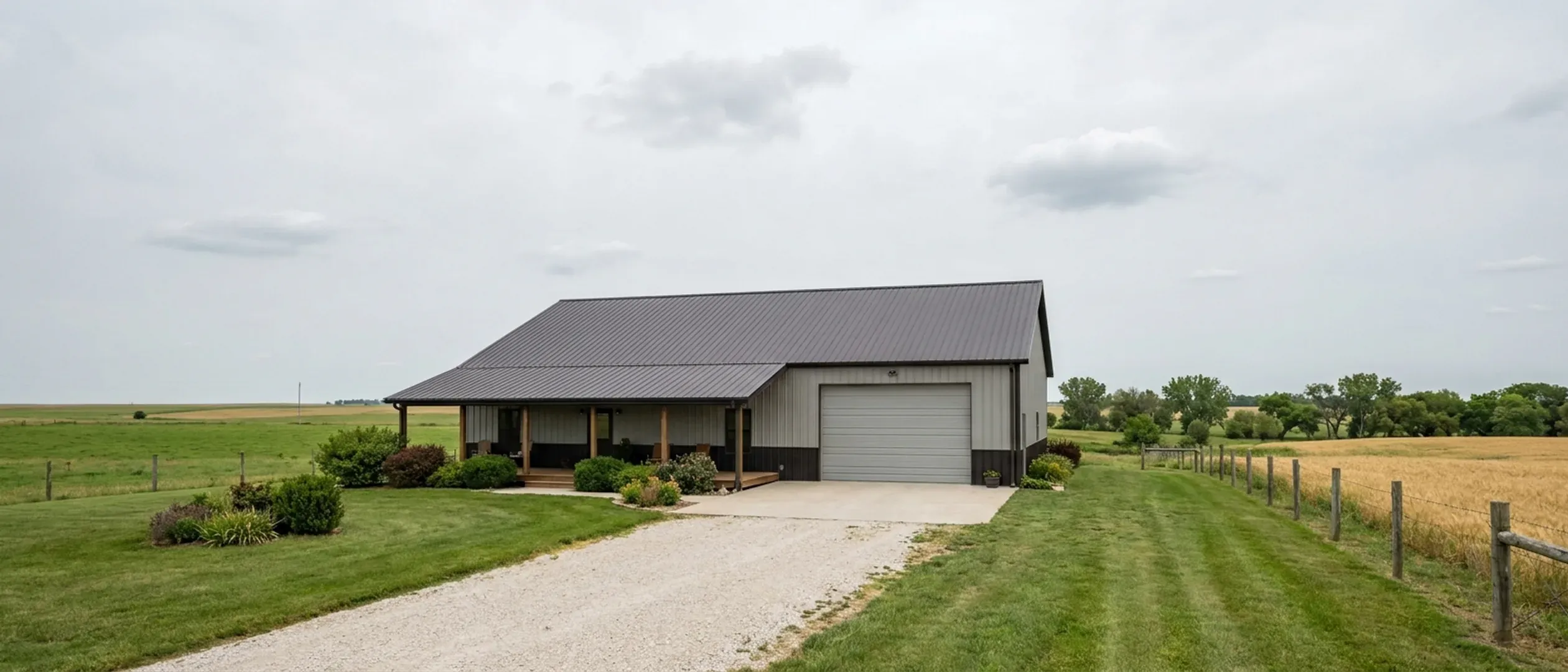
How Big a Barndominium Can You Build in Kansas for $100,000, $200,000 or More?
The question most people start with is how much house a budget buys. The answer depends less on the building than on what comes off the top first: the land, the septic system or sewer, the well or water hookup, the driveway and the power. Only what is left pays for square footage. This guide sets out the method, uses the Census Bureau's published cost per square foot for custom homes in the Midwest, which includes Kansas, and runs it at five hypothetical budgets from $100,000 to $500,000. Those are example budgets a reader might have, not prices. The results are arithmetic on third-party figures, not a price from us.
Figures below are industry data from cited third-party sources, not a quote from Kansas Barndominium Builders. Every project is priced individually.
Bottom Line Up Front
- Divide the money left after land and site costs by a published cost per square foot. Using the Census Bureau's 2025 Midwest contract price for contractor-built homes ($194.09 median, $202.13 average), a hypothetical $100,000 building budget covers about 490 to 520 finished square feet and $200,000 about 990 to 1,030.
- At the same Census rates, $300,000 covers about 1,480 to 1,550 finished square feet, $400,000 about 1,980 to 2,060, and $500,000 about 2,470 to 2,580.
- Shop space costs less per foot than finished living space, so a budget buys more total building when part of it is shop. The Census figures describe finished houses, not shop area.
Published cost figures
Third-party and government figures, each with its source. None of them is a quote, and none of them is ours.
| Measure | Range | Source |
|---|---|---|
| Contractor-built houses on the owner's land, Midwest, started in 2025: median to average contract price (land excluded) | $194–$202 per sq ft | U.S. Census Bureau, Characteristics of New Housing 2025: Midwest median $194.09, average $202.13 contract price per sq ft (read 26 Sep 2026) — https://www.census.gov/construction/chars/xls/contractpricesqft_cust.xls |
Total cost by size
Rough totals at common sizes. These move with everything on this page, so treat them as a starting orientation, not an estimate for your project.
1,000 sq ft
$194,000–$202,000
Arithmetic, rounded to the nearest $1,000: 1,000 sq ft × the Census 2025 Midwest contract price per sq ft ($194.09 median, $202.13 average), land excluded — https://www.census.gov/construction/chars/xls/contractpricesqft_cust.xls
1,500 sq ft
$291,000–$303,000
Arithmetic, rounded to the nearest $1,000: 1,500 sq ft × the Census 2025 Midwest contract price per sq ft ($194.09 median, $202.13 average), land excluded — https://www.census.gov/construction/chars/xls/contractpricesqft_cust.xls
2,000 sq ft
$388,000–$404,000
Arithmetic, rounded to the nearest $1,000: 2,000 sq ft × the Census 2025 Midwest contract price per sq ft ($194.09 median, $202.13 average), land excluded — https://www.census.gov/construction/chars/xls/contractpricesqft_cust.xls
2,500 sq ft
$485,000–$505,000
Arithmetic, rounded to the nearest $1,000: 2,500 sq ft × the Census 2025 Midwest contract price per sq ft ($194.09 median, $202.13 average), land excluded — https://www.census.gov/construction/chars/xls/contractpricesqft_cust.xls
What actually moves the number
Land comes off the top
USDA's 2026 survey averages Kansas pasture at $2,400 an acre and non-irrigated cropland at $3,450. As arithmetic, five acres at those USDA averages is $12,000 to $17,250, but a small homesite near a city usually sells well above farmland averages, so price your actual parcel.
Water and wastewater
Off the city grid you pay for your own. Johnson County's 2026 fees are $475 for a soil profile analysis and $480 for a new-home septic permit, before the system itself; Butler County Rural Water District No. 5 lists a $4,016 benefit unit plus an impact fee of $2,210 to $4,420 for most homes.
Finish level
The Census figure is a median and an average across finished custom homes. A plain finish schedule builds more square feet per dollar than a high one, because interior finishes are the biggest stage in NAHB's 2024 cost survey at 24.1% of construction cost.
How much is shop
A shop with a slab, insulation and a few circuits costs much less per foot than a finished room with plumbing and HVAC. The Census cost per square foot covers finished houses, so do not apply it to shop area.
The method, step by step
Four steps turn a total budget into a realistic building size.
1. Start from the total you can spend
Include the loan amount and the cash or land equity you will put in. Our financing guide covers how lenders treat land you already own.
2. Take off land and site costs
Subtract the land (if you do not own it), the septic system or sewer connection, the well or rural water hookup, the driveway, the power line and the permit fees. On rural Kansas land these are real money before any building exists.
3. Hold back a contingency
Keep part of the remainder aside for the things nobody knows until the ground is open: rock, a longer power run, a septic design that needs a different system type. The size of the reserve is your decision; the point is not to spend it on square footage.
4. Divide by a published cost per square foot
Divide what remains by a cost per square foot for finished custom homes. The Census Bureau's 2025 Midwest figures for contractor-built homes are $194.09 median and $202.13 average. Treat the result as finished living space; shop area is budgeted separately.
What hypothetical building budgets cover
These are example budgets, left after land and site costs, divided by the Census Bureau's 2025 Midwest contract price per square foot. They are reader budgets, not our prices. Rounded, arithmetic only.
A $100,000 building budget
At the Census Bureau's Midwest median of $194.09 and average of $202.13 per square foot, $100,000 covers about 490 to 520 finished square feet. That is a small cabin-sized home, or a larger unfinished shell with a small finished apartment inside it.
A $200,000 building budget
At the Census Bureau's Midwest median of $194.09 and average of $202.13 per square foot, $200,000 covers about 990 to 1,030 finished square feet. That is a compact two- or three-bedroom home, or a smaller living area with a larger unfinished shop.
A $300,000 building budget
At the same Census rates, $300,000 covers about 1,480 to 1,550 finished square feet, the size of a comfortable three-bedroom single-story home.
A $400,000 building budget
At the same Census rates, $400,000 covers about 1,980 to 2,060 finished square feet, close to the median Midwest contractor-built home.
A $500,000 building budget
At the same Census rates, $500,000 covers about 2,470 to 2,580 finished square feet, slightly more than a fully finished 40x60 footprint of 2,400 square feet.
How big Midwest custom homes actually are
The Census Bureau also records the size of contractor-built homes, which shows where most budgets land.
The median is about 2,300 square feet
Contractor-built homes completed in the Midwest in 2025 had a median floor area of 2,289 square feet and an average of 2,471, according to the Census Bureau.
Under 1,800 square feet is common
In the same Census table, 15% of Midwest contractor-built homes completed in 2025 were under 1,400 square feet and another 16% were 1,400 to 1,799, so almost a third were under 1,800 square feet.
The middle of the range
The Census Bureau reports 23% between 1,800 and 2,399 square feet and 18% between 2,400 and 2,999 in 2025.
Large homes are a minority
Eighteen percent were 3,000 to 3,999 square feet and 10% were 4,000 or more, according to the same Census table.
Getting more building from the same budget
The cost per square foot is not fixed. These choices move it.
Finish in phases
Build the full shell and finish part of it now, leaving the rest as shop or future space. Unfinished area under the same roof costs far less than finished rooms, and you can finish it later without a new foundation or roof.
Keep the plumbing together
Kitchens, bathrooms and laundry that share walls need less pipe and fewer runs. NAHB puts plumbing at 6.3% of construction cost; a compact wet core is one of the few ways to reduce it.
Choose a simple footprint
A rectangle under one roof is the cheapest shape to frame and clad. Every jog, dormer and roof intersection adds material and labor.
Pick finishes last, but budget for them first
Interior finishes are NAHB's largest stage at 24.1% of construction cost. Setting an allowance for each room before the plan is drawn keeps square footage and finish level from competing for the same dollars later.
Reading this because you are weighing a build? The next step is a plan drawn for your program.
What's different about Kansas
Septic size follows bedrooms
Where a county has no sanitary code of its own, KDHE Bulletin 4-2 sizes a septic system at 150 gallons per day per bedroom with a 1,000-gallon minimum tank. Adding a bedroom can enlarge the system; adding floor area without bedrooms does not.
Some rural water districts charge by living space
The one-time impact fee Butler County's Rural Water District 5 charges is $2,210 under 2,000 square feet of living space and $4,420 from 2,000 to 2,999, so the size of the house can move a water bill that is paid before it is built. Every district sets its own schedule.
Permit fees can scale with value
Johnson County's residential permit fee rises with the building valuation, at $5 per $1,000 between $100,000 and $500,000. Many rural Kansas counties issue no residential permit, so check with the county before you budget for one.
Kansas land varies by region
K-State's 2025 land values book finds the highest agricultural land prices per acre in the Northeast region and the lowest in the Southwest, so the same budget leaves more for the building in some parts of the state than others.
How big of a barndominium can I build for $100,000 in Kansas?
How big of a barndominium can I build for $200,000 in Kansas?
How much does a 2,000 square foot barndominium cost in Kansas?
How much does a 40x60 barndominium cost to build in Kansas?
Is a barndominium cheaper to build than a house?
Does shop space cost the same per square foot as living space?
How much should I set aside for land and site costs?
Why use Midwest figures rather than Kansas figures?
Can you size a plan to my budget?
Questions answered? Tell us what you want to build and we will put real numbers against it.
Sources
- U.S. Census Bureau — Contract Price per Square Foot of New Contractor-Built Single-Family Houses Started (2025) — Midwest 2025: median $194.09, average $202.13. Read 26 Sep 2026.
- U.S. Census Bureau — Square Feet of Floor Area in New Single-Family Houses Completed (2025) — Contractor-built, Midwest 2025: median 2,289, average 2,471; size distribution 15/16/23/18/18/10%. Read 26 Sep 2026.
- NAHB — Cost of Constructing a Home 2024 — Interior finishes 24.1%, rough-ins 19.2%, plumbing 6.3%. Read 26 Sep 2026.
- USDA National Agricultural Statistics Service — Land Values 2026 Summary — Kansas pasture $2,400, non-irrigated $3,450, irrigated $4,600 per acre. Read 26 Sep 2026.
- K-State Agricultural Economics and KSFMRA — Kansas Agricultural Land Values and Trends 2025 — Northeast highest, Southwest lowest price per acre. Read 26 Sep 2026.
- Johnson County Environmental Division — 2026 septic installation permit and soil profile applications — Soil profile analysis $475; new-home septic permit $480 (linked 2026 PDFs). Read 26 Sep 2026.
- Johnson County Building Codes — Residential Building Permit Fee Chart — $5 per $1,000 of valuation between $100,000 and $500,000. Read 26 Sep 2026.
- Butler County Rural Water District No. 5 — Meter Connection Fees and Impact Fees — Benefit unit $4,016 (meter connection page); impact fee $2,210 / $4,420 by living space. Read 26 Sep 2026.
- KDHE Bulletin 4-2 — Minimum Standards for Design and Construction of Onsite Wastewater Systems — 150 gpd per bedroom; 1,000-gallon minimum tank. Read 26 Sep 2026.
Keep reading
The pages that answer the next question this one raises.
Cost to build a barndominium in Kansas
The full sourced cost picture, including real Kansas site fees.
Read it30x40 barndominium plans
A 1,200-square-foot footprint, in the range a $200,000 to $250,000 building budget reaches at Census Midwest rates.
Read it40x60 barndominium plans
A 2,400-square-foot footprint, often split between living space and shop.
Read itSmall barndominium plans
Compact layouts for tighter budgets.
Read itBarndominium financing in Kansas
How the budget is funded: construction loans, Farm Credit lenders and the Kansas rural loan guarantee.
Read itWant a real number instead of a range?
Start the survey and tell us about your land and what you want to build. Include the county and parcel ID if you have them, because in Kansas the jurisdiction, the soil and the well and septic answers change the budget more than the building does. The survey costs nothing.