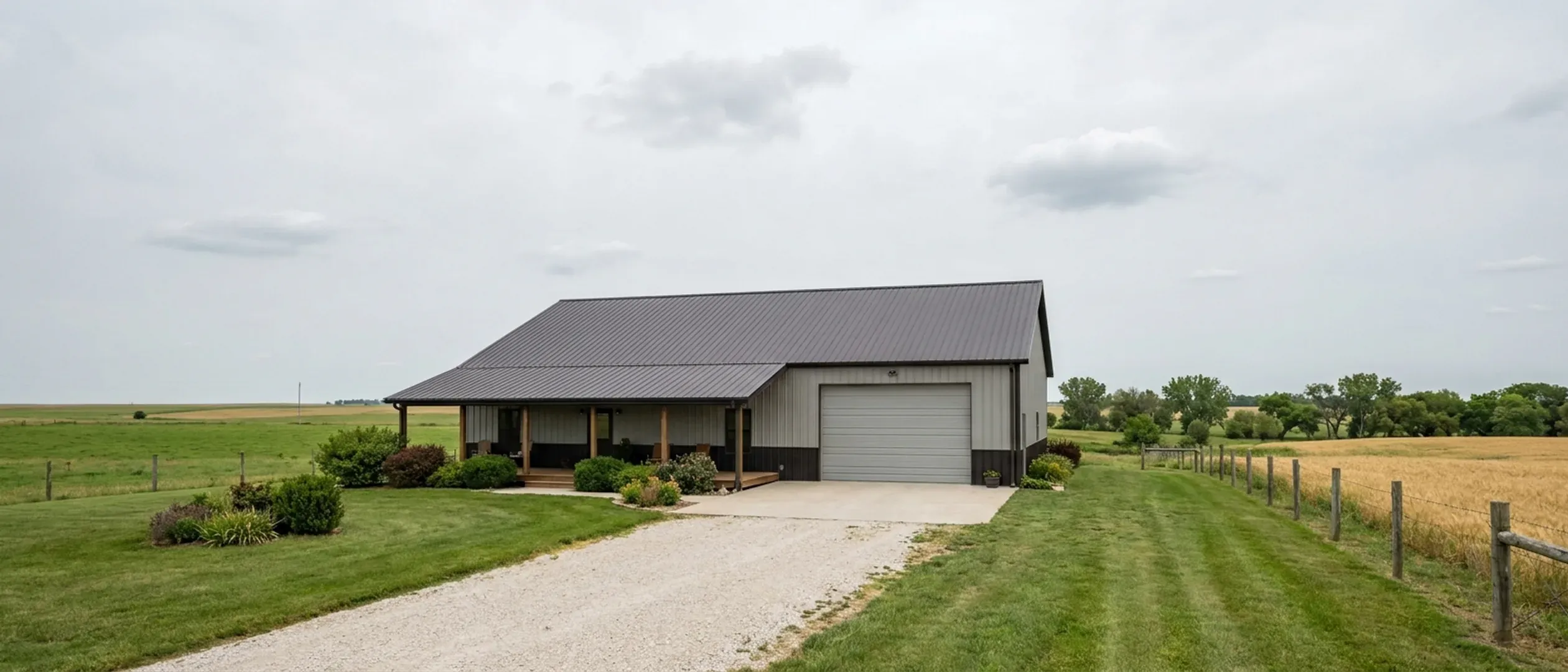
Barndominium vs. House Cost in Kansas: Which Is Cheaper to Build?
The claim that a barndominium costs half as much as a house is repeated everywhere and sourced almost nowhere. The honest answer is narrower. A steel or post-frame shell replaces the framing, roofing and siding of a conventional house, and those lines are a real but limited share of what a house costs. Everything inside the walls, and everything in the ground around it, costs the same whichever way the house is framed. This guide uses NAHB's national cost breakdown to show which lines move, and Census Bureau figures to show what homes in Kansas and the Midwest actually cost to build. No figure here is our price.
Figures below are industry data from cited third-party sources, not a quote from Kansas Barndominium Builders. Every project is priced individually.
Bottom Line Up Front
- In NAHB's 2024 cost survey, framing was 16.6% of construction cost and exterior finishes 13.4%. A barndominium shell mostly replaces those two lines, about 30% of the budget.
- Interior finishes (24.1%) and the plumbing, electrical and HVAC rough-ins (19.2%) were more than 43% of NAHB's average construction cost, and they cost the same in a barndominium.
- For comparison, Census Bureau permit data puts the average permit valuation of a new single-family home in Kansas at about $349,400 in 2025, land excluded.
Published cost figures
Third-party and government figures, each with its source. None of them is a quote, and none of them is ours.
| Measure | Range | Source |
|---|---|---|
| Contractor-built houses on the owner's land, Midwest, started in 2025: median to average contract price (land excluded) | $194–$202 per sq ft | U.S. Census Bureau, Characteristics of New Housing 2025: Midwest median $194.09, average $202.13 contract price per sq ft (read 26 Sep 2026) — https://www.census.gov/construction/chars/xls/contractpricesqft_cust.xls |
| Detached new houses sold by builders, Midwest, 2025: median to average sales price (lot excluded) | $160–$170 per sq ft | U.S. Census Bureau, Characteristics of New Housing 2025: detached, Midwest median $160.00, average $169.78 per sq ft (read 26 Sep 2026) — https://www.census.gov/construction/chars/xls/soldpricesqft_cust.xls |
| Average permit valuation per new single-family home authorized in Kansas, 2025 (structure only) | $349,400 per home | U.S. Census Bureau, Building Permits Survey, annual 2025: Kansas 1-unit, 6,121 units, valuation $2,138,873 thousand; per-home figure is arithmetic (read 26 Sep 2026) — https://www.census.gov/construction/bps/xls/stateannual_202599.xls |
What actually moves the number
How much of the shell you actually change
NAHB's framing line includes trusses and sheathing, and its exterior line includes wall finish, roofing and windows and doors. A metal-clad post-frame or steel shell replaces most of the framing, siding and roofing, but you still buy windows and doors, which NAHB puts at 3.7% of construction cost.
Insulation and interior walls
A metal building still needs its walls and roof insulated and its rooms framed and finished inside. NAHB puts insulation at 1.6% and drywall at 3.3% of construction cost in a conventional house; a barndominium does not avoid either.
The finish schedule
Cabinets, counters, flooring, plumbing fixtures and appliances sit in NAHB's interior finishes line, the biggest stage in its survey at 24.1%. A barndominium with a high-end kitchen costs what a house with that kitchen costs.
The shop
Much of the reason people build barndominiums is the attached shop. Shop square footage is cheaper per foot than living space because it is not finished, but it is still building, and it is the part of a barndominium budget a conventional house comparison usually leaves out.
Where a barndominium can cost less
These are the NAHB cost lines a steel or post-frame shell with metal siding and roofing actually replaces.
Framing
NAHB's 2024 survey puts framing, including trusses and sheathing, at 16.6% of construction cost. A post-frame or steel structure carries the roof on widely spaced posts or frames instead of stud walls and rafters, and that is where most of the claimed savings comes from.
Siding and roofing
NAHB's exterior finishes stage was 13.4% of construction cost, with exterior wall finish at 5.7% and roofing at 3.9%. Metal panels on both the walls and the roof replace most of those two lines in one material.
Fewer interior bearing walls
Clear-span framing lets the floor plan put walls where you want rooms rather than where the roof needs support. That does not remove interior walls, but it can simplify them.
What it adds up to
Framing and exterior finishes together were about 30% of NAHB's average construction cost. Even a large saving on those lines is a much smaller saving on the whole house. As arithmetic, cutting both lines by a fifth would lower the total by about 6%.
Where it costs the same
Most of a house is inside the walls and under the ground, and none of it depends on the frame.
Plumbing, electrical and HVAC
NAHB puts the mechanical rough-ins at 19.2% of construction cost: plumbing 6.3%, electrical 6.4% and HVAC 6.3%. A barndominium needs the same systems, and licensed trade contractors handle plumbing, electrical and HVAC in either kind of house.
Interior finishes
At 24.1% in NAHB's survey, interior finishes (insulation, drywall, trim, painting, lighting, cabinets, counters, flooring, fixtures and appliances) are the biggest single stage, and they are chosen room by room, not by frame type.
Foundation and site work
Foundations were 10.5% of NAHB's average construction cost and site work 7.6%. A barndominium usually sits on a slab, and the slab, the pad, the driveway and the utilities cost what the site dictates.
Final steps
NAHB's final steps stage (landscaping, decks and porches, driveway, clean-up) was 6.5%. A wrap-around porch on a barndominium costs what a porch costs.
What homes in Kansas and the Midwest cost to build
The Census Bureau publishes two useful comparisons: what houses cost per square foot in the Midwest, and what Kansas permits say new homes are worth.
Kansas permit valuations
Census Building Permits Survey data show 6,121 new single-family homes authorized in Kansas in 2025, with a combined permit valuation of $2.14 billion, which works out to about $349,400 per home, land excluded. The survey counts only places that issue permits, so it leans toward cities and suburbs.
Custom versus built-to-sell
The Census Bureau reports Midwest contractor-built houses on the owner's land at a median of $194.09 per square foot in 2025, against $160.00 for detached houses builders sold. A barndominium is almost always the first kind, so compare it with custom homes, not tract homes.
The same size, the same order of cost
The median Midwest contractor-built home completed in 2025 was 2,289 square feet, according to the Census Bureau. A barndominium of that size with the same finishes starts from the same interior and mechanical budget; the difference is in the shell.
The comparison people skip
A conventional house with a detached three-car garage and a separate shop building is the fair comparison for many barndominium plans. Putting the shop under the same roof as the house is where a barndominium plan often saves, because it is one foundation and one roof instead of two.
Resale, appraisal and insurance
A lower build cost is only half the comparison. What the house is worth afterward matters as much.
Appraisals rely on comparable sales
An appraiser values a house largely from sales of similar houses nearby. With few barndominium sales in most Kansas counties, a new one can appraise below its cost. Our financing guide covers the Kansas program that guarantees part of that gap.
Some lenders count the shop
American AgCredit, which has Kansas offices, says barns, shops and outbuildings can be included in the appraised value on its rural home loans. Lender policy on shop space varies, so ask before you design around it.
Ask your insurer before you build
Insurers price a house by its construction type, and Kansas sees hail and high wind. Ask your insurance agent how they rate a metal roof and a post-frame or steel structure before the design is final.
Buyers for barndominiums exist, but fewer of them
A barndominium on acreage with a shop suits a particular buyer. That can mean a longer sale, and it is a reason to design the house part to read as a house: real rooms, normal ceiling heights in living space, and a proper entry.
Reading this because you are weighing a build? The next step is a plan drawn for your program.
What's different about Kansas
The land and site costs are identical
USDA's 2026 survey puts Kansas non-irrigated cropland at $3,450 an acre and pasture at $2,400. A barndominium and a conventional house on the same parcel pay the same for the land, the driveway, the septic permit and the well or rural water hookup, so none of the shell savings reach those lines.
Permit fees follow the value, not the frame
Where a Kansas county or city charges a permit fee by valuation, such as Johnson County's residential schedule, a cheaper shell means a slightly smaller fee. Where a rural Kansas county issues no residential permit, there is no fee either way.
Kansas does not tax the installing labor on a new home
K.S.A. 79-3603(p) excludes installation services in the original construction of a residence from sales tax. That applies to a barndominium and a conventional house alike, so it does not change the comparison.
Steel framing is rare in Midwest homes
The Census Bureau reports that 96% of contractor-built homes completed in the Midwest in 2025 were wood-framed and 2% steel-framed. A steel-framed barndominium is unusual in the Census data, which is one reason appraisers find few comparable sales.
Pros and cons, honestly
Pros
- A post-frame or steel shell replaces most of the framing, siding and roofing, which NAHB puts at about 30% of construction cost.
- House and shop under one roof can mean one foundation and one roof instead of two buildings.
- Clear-span framing gives flexibility in where interior walls go.
- Metal roofing and siding are one material for both walls and roof.
Cons
- Interior finishes and mechanical systems, more than 43% of NAHB's average construction cost, cost the same.
- Land, septic, well and hookup costs are identical to a conventional house on the same parcel.
- Few comparable sales can mean an appraisal below cost.
- The shop adds building area that a house-to-house comparison leaves out.
Is it cheaper to build a barndominium or a house in Kansas?
What does it cost to build a house in Kansas?
Why do some websites say barndominiums cost half as much?
Does a metal barndominium cost less to insure in Kansas?
Do barndominiums appraise lower than houses?
Is a shouse cheaper than a house plus a separate shop?
Can you tell me which is cheaper for my land?
Questions answered? Tell us what you want to build and we will put real numbers against it.
Sources
- NAHB — Cost of Constructing a Home 2024 (Eric Lynch, 20 Jan 2025) — Table 3 stage and line shares. Read 26 Sep 2026.
- U.S. Census Bureau — Contract Price per Square Foot of New Contractor-Built Single-Family Houses Started — Midwest 2025: median $194.09, average $202.13. Read 26 Sep 2026.
- U.S. Census Bureau — Price per Square Foot of Floor Area in New Single-Family Houses Sold — Detached, Midwest 2025: median $160.00, average $169.78. Read 26 Sep 2026.
- U.S. Census Bureau — Square Feet of Floor Area in New Single-Family Houses Completed — Contractor-built, Midwest 2025 median 2,289 sq ft. Read 26 Sep 2026.
- U.S. Census Bureau — Type of Framing in New Single-Family Houses Completed — Contractor-built, Midwest 2025: wood 96%, steel 2%. Read 26 Sep 2026.
- U.S. Census Bureau — Building Permits Survey, annual state valuation and units, 2025 — Kansas 1-unit: 6,121 units; valuation $2,138,873 thousand. Read 26 Sep 2026.
- USDA National Agricultural Statistics Service — Land Values 2026 Summary — Kansas non-irrigated cropland $3,450, pasture $2,400 per acre. Read 26 Sep 2026.
- American AgCredit — Rural Home Loans — Barns, shops and outbuildings can be included in the appraised value. Read 26 Sep 2026.
- Kansas Statutes — K.S.A. 79-3603, subsection (p) — Read 26 Sep 2026.
- Johnson County Building Codes — Building Permit Fee Chart — Valuation-based residential permit fees. Read 26 Sep 2026.
Keep reading
The pages that answer the next question this one raises.
Cost to build a barndominium in Kansas
The full cost picture: construction prices, land values and real Kansas permit, septic and water fees.
Read itBarndominium financing in Kansas
Construction loans, Farm Credit lenders and the Kansas guarantee for the appraisal gap.
Read itPole barn and post-frame homes
The post-frame shell in detail: what it is and where it saves.
Read itBarndominium with a shop
The house-plus-shop layout that is the fairest comparison with a house and a separate building.
Read itWant a real number instead of a range?
Start the survey and tell us about your land and what you want to build. Include the county and parcel ID if you have them, because in Kansas the jurisdiction, the soil and the well and septic answers change the budget more than the building does. The survey costs nothing.