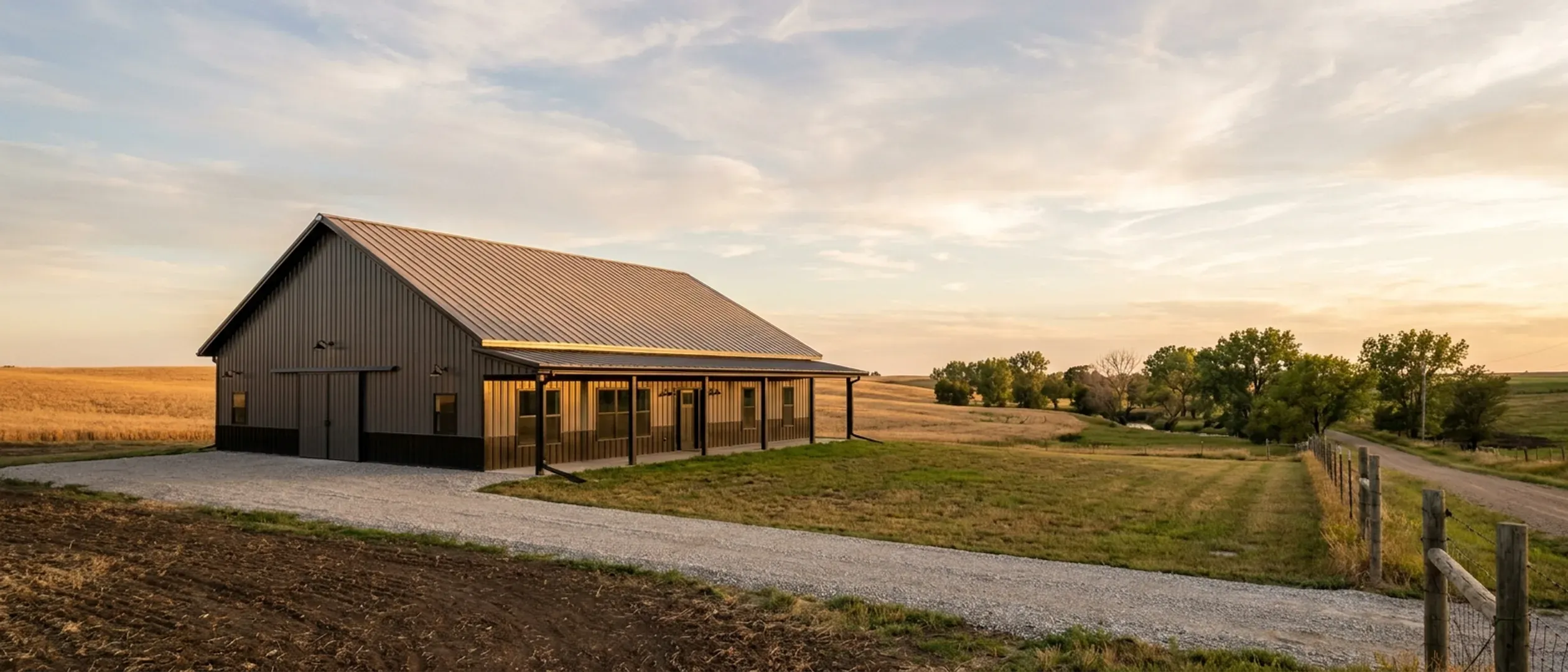
Are Barndominiums Legal in Kansas? Local Codes, the Farm Exemption and Septic Rules
Nothing in Kansas law singles out a barndominium. A post-frame or steel-framed house is a house, and it is regulated by whatever rules reach the parcel it stands on. The difficulty is that in Kansas those rules are almost entirely local. The State has adopted no residential building code, so whether a plan reviewer and a framing inspector ever see your build depends on the city or county, and some counties that issue a building permit have adopted no building code at all. Layered on top are a handful of rules that do apply everywhere: the septic standards (a county sanitary code, or the State's own bulletin where a county has none), the water-well rules, the statewide roofing-contractor registration, the energy-efficiency disclosure on a newly built home that is sold, and the law that decides who may call themselves an architect or engineer. This guide walks through each layer, quotes the statute or document behind it, and says plainly where the sources disagree, which on the question most rural buyers ask, whether a house on farmland escapes county zoning, they do.
Figures on this page are cited third-party or government data, not a quote from Kansas Barndominium Builders.
Bottom Line Up Front
- A barndominium is legal anywhere in Kansas a house is legal. The two questions that matter are zoning (can a dwelling go on this parcel) and which codes reach it, and both are answered by your city or county, not by the building type.
- Kansas has no statewide residential building code. The State adopts an energy code only for new commercial and industrial buildings (K.S.A. 66-1227); cities and counties decide whether to adopt a residential code, and which edition.
- The agricultural exemption in K.S.A. 19-2921 and 12-758 keeps county zoning off land and buildings used for agricultural purposes, but whether a house qualifies depends on the facts. The Kansas Supreme Court applied it to a farmer's own home on a 40-acre working farm and expressly declined to decide anything wider.
Zoning: can a house go on this parcel at all?
Zoning is the first gate, and it is a different question from the building code. Inside a city it is city zoning; in unincorporated areas it is county zoning where the county has adopted it; and a city may extend zoning and building codes a short way beyond its limits.
Check the zoning district before you buy
Agricultural and rural districts usually allow a single-family dwelling, but minimum tract size, road frontage and setbacks are set by the local regulations. Blauvelt began exactly this way: Leavenworth County refused a building permit because the 40-acre tract was not a recorded lot of record and did not front a public road. Ask the planning office which district the parcel is in and what it requires of a dwelling.
Land just outside a city can fall under that city
K.S.A. 12-751(b) lets a city, in conjunction with its subdivision or zoning regulations, adopt and enforce building codes outside the city limits, and K.S.A. 12-758(b) refers to a city's regulations under 12-715b for land outside its boundary. A parcel a mile past the city limit sign is not automatically county-only.
Applying for the agricultural determination
Counties can ask for a prior determination that a building qualifies (Attorney General Opinion 2016-10). Douglas County's published packet shows what that looks like: a Schedule F farm income filing for the preceding year or, for a new producer, a business plan or agricultural loan; at least three acres in agricultural use across the operation; a site plan; and road-access approval. Its affidavit defines an agricultural building as one that shall not be a place of human habitation, and says a change of use from agricultural requires a building permit.
A shop with living quarters is not a barn
The exemption follows use. A machine shed or hay barn used only for farming can sit outside county zoning and county construction codes; the moment the building contains a home, the statutory words used for agricultural purposes and not otherwise become the question, and the answer turns on the Blauvelt facts rather than on the building's shape. Plan the permit path for a shouse as for a house.
Building codes, plans and the words architect and engineer
Where a code is adopted it applies to a barndominium exactly as to any other house. What a steel or post-frame house changes is the paperwork a building department asks for.
Kansas lets non-architects prepare plans for a one- or two-family home
K.S.A. 74-7031(b) and 74-7033(b) exempt persons preparing plans, drawings or specifications for buildings housing no more than two dwelling units in one contiguous structure, or for agricultural buildings, from the architecture and engineering licensing requirements. That is the licensure floor.
A local building department can still ask for a sealed design
Johnson County's permit page for new single-family dwellings (unincorporated areas) lists steel framed construction and pole barn post-framed construction among designs that shall be designed and sealed by a licensed design professional, and requires post-frame construction drawings to be engineer sealed, designed to the 2018 International Building Code for a 115 mph wind load at exposure C and a 20 psf roof snow load. Those are Johnson County's figures for its own unincorporated area, not a state standard. K.S.A. 74-7038 also lets building officials refuse technical submissions that are not sealed unless the applicant certifies a specific exemption.
Who may use the titles
K.S.A. 74-7001 makes it unlawful to practise or offer to practise architecture, engineering, landscape architecture, geology or surveying without a licence, and K.S.A. 74-7029 treats advertising a title that conveys the impression of licensure as a misdemeanour. When a builder says the frame is engineered, the engineering belongs to the manufacturer or a third-party design professional, and the drawings should say whose seal they carry.
The energy disclosure on a newly built home that is sold
K.S.A. 66-1228 requires the person building or selling a previously unoccupied new single-family residence to disclose its energy-efficiency information to the buyer before the purchase contract is signed, on the Kansas Corporation Commission's form. It is a disclosure, not a code: the form compares the house with 2006 reference values but does not require them.
Septic, wells and the dig notice
These are the rules most likely to reach a rural parcel with no building code at all.
The county sanitary code, or Bulletin 4-2
Where a county has a sanitary code, its environmental or health office issues the septic permit; where it has none, KDHE's Bulletin 4-2 standards apply and KDHE handles variances (K.A.R. 28-5-9). The bulletin notes that some local codes require a perc test and others require both a perc test and a soil profile evaluation, and that many soils, especially in eastern Kansas, restrict the use of conventional absorption fields.
Fifty feet from any well
K.A.R. 28-5-2 prohibits any wastewater disposal system within 50 feet of a water well or spring. County codes can be stricter. Site the well, the septic field and the building together, before the pad is placed.
A household well needs no water-right permit, but the driller is regulated
K.S.A. 82a-705 requires the chief engineer's approval for a new appropriation of water for other than domestic use; domestic use, defined in K.S.A. 82a-1203(d) as household purposes, watering farm animals and irrigating up to two acres of garden, orchard or lawn, is outside that requirement. Well construction is regulated separately: a water well contractor is licensed, though a person drilling a domestic well on their own home land to the minimum standards is excluded.
Two working days before anyone digs
K.S.A. 66-1804 requires an excavator to give notice of intent to excavate at least two full working days, and not more than 20 calendar days, before the start date, so buried utilities can be marked. The notice is valid for 20 calendar days after the start date.
Lenders, appraisal and private restrictions
Legal to build is not the same as easy to finance or permitted by the deed. These layers sit outside public law.
Covenants and associations
A recorded declaration can forbid metal siding, post-frame construction or a shop building even where zoning allows them. Riley County's residential application asks applicants to verify whether the property is subject to a homeowner association, covenants, conditions and restrictions or an improvement district. Where there is an association, the Kansas Uniform Common Interest Owners Bill of Rights Act (K.S.A. 58-4601 et seq.) governs how it operates, but it does not override the declaration's use restrictions.
The county's agricultural value is not the lender's value
Kansas values agricultural land for property tax on its productive capability, not fair market value, according to the Department of Revenue's Property Valuation Division. A lender's appraiser values the house and its site on sales of comparable property. Do not read a low tax valuation on farmland as what the finished homesite will appraise for.
Where no inspector came, keep your own record
On a parcel with no building code, no one issues a certificate of occupancy. Lenders and later buyers may ask what standard the house was built to, so keep the sealed drawings, the manufacturer's engineering, the septic permit and inspection report, and photographs of footings and framing before they were covered.
The questions to put to your city or county
Each answer changes what you build and how long it takes. Get them in writing before you close on land.
Which office has jurisdiction over this parcel?
City, county, or a city's extraterritorial area. In Johnson County the permit pages tell applicants to confirm first that the address returns Unincorporated Area before applying to the county.
Is a building code adopted, and which edition?
And does the department require sealed drawings for steel or post-frame construction, as Johnson County does?
Who issues the septic permit, and is a perc test or soil profile required?
The county sanitary code decides; where there is none, KDHE's Bulletin 4-2 applies.
Is an agricultural determination available, and on what evidence?
Only relevant if the parcel is genuinely farmed. Ask what the county requires and whether a dwelling can ever qualify there.
Does the contractor need a local licence here?
Johnson County and the Wichita/Sedgwick County department license contractors; many rural counties do not. Roofing registration with the Attorney General applies statewide.
Reading this because you are weighing a build? The next step is a plan drawn for your program.
What's different about Kansas
There is no statewide residential building code
The Kansas Corporation Commission, which runs the State's energy office, puts it in one sentence: because Kansas is a home rule state, the responsibility for adoption and enforcement of building energy codes lies with local jurisdictions. The only building code the Legislature itself adopts is the 2006 International Energy Conservation Code for new commercial and industrial structures (K.S.A. 66-1227(a)), and the same statute says the commission has no authority to adopt or enforce energy standards for residential structures and that nothing prevents a city or county from adopting its own. Cities and counties adopt model codes by reference, so the edition in force, the amendments and the design figures all vary by jurisdiction.
A permit and a building code are not the same thing
Riley County is the clearest example. Its Building Division states that Riley County has not adopted building codes, and in the next breath that a building permit is required before construction of any building or structure, to determine proper zoning, setbacks and sanitary code compliance. Its residential application lists Shouse (shop/house) as a building type alongside stick-built and modular. So in Riley County you apply, pay and get a permit, but no plan reviewer measures the framing against an adopted residential code. Elsewhere the opposite end applies: unincorporated Johnson County adopted the 2018 International Codes, effective 1 July 2020, and inspects footings through final.
The agricultural exemption: what the statutes say
K.S.A. 19-2921 (county zoning) and K.S.A. 12-758(b) (city and county planning and zoning) use almost the same words: except for flood plain regulations in areas designated as a flood plain, zoning regulations shall not apply to the use of land for agricultural purposes, nor to the erection or maintenance of buildings thereon for such purposes so long as such land and buildings are used for agricultural purposes and not otherwise. Attorney General Opinion 2016-10 reads the same statutes as keeping county construction codes off a building used solely for agricultural purposes, and says a county may require a prior determination that a building qualifies. Flood plain rules are carved out of the exemption in both statutes.
Does it cover a house? The sources disagree in emphasis
The Revisor of Statutes' one-line annotation to 19-2921 summarises Blauvelt v. Board of Leavenworth County Commissioners (1980) as holding that agricultural-purpose buildings include a dwelling place. The court's own opinion is narrower. It asked whether a dwelling on a farm occupied by the owner-farmer serves an agricultural purpose, answered yes on those facts, and said its decision was limited to 40 acres of admitted agricultural land occupied by a farmer-owner who intended to live and farm there, expressly not deciding small tracts with a vegetable garden and a few chickens. Attorney General Opinion 2018-4 follows the narrow reading: whether a dwelling is used for agricultural purposes depends on the facts, and qualification cannot be established by an objective test such as a minimum acreage. For a buyer the practical reading is the court's own: a house lived in by the family that genuinely farms the land has been treated as agricultural; a house that simply sits on rural acreage has not.
Septic is county-first, with a State fallback
K.A.R. 28-5-7 requires every private sewer system to meet the county sanitary code approved by the Kansas Department of Health and Environment, or, in the absence of such a code, KDHE Bulletin 4-2. KDHE publishes the county codes one by one, from codes adopted in the late 1980s to Johnson County's Environmental Sanitary Code of August 2024. The agricultural exemption does not reach this: in Blauvelt itself the court recorded that there was no dispute over the requirement for a permit for the septic system, even while holding the house itself outside county zoning.
Contractor licensing is local, with one statewide exception
Kansas has no statewide general or residential contractor licence. K.S.A. 12-1557 speaks of any county or city requiring the licensure of general, building and residential contractors, and standardises the exam such a jurisdiction may use; it imposes no licence itself. Johnson County's Contractor Licensing division issues 11 licence types, including a Class C residential licence covering single-family and duplex residences, which does not cover HVAC, plumbing, electrical or fire protection work. In Wichita and unincorporated Sedgwick County the Metropolitan Area Building and Construction Department handles contractor licensing and permits. The statewide exception is roofing: under the Kansas Roofing Registration Act (K.S.A. 50-6,121 et seq.) anyone who engages in or offers roofing services needs a registration certificate from the Attorney General, with a narrow exemption for a general contractor whose roofing is no more than half of the project cost.
Pros and cons, honestly
Pros
- Nothing in Kansas law treats a barndominium differently from a conventional house, so there is no special approval or product listing to obtain because of the structural system.
- Kansas lets plans for a one- or two-family house be prepared without an architect or engineer (K.S.A. 74-7031(b), 74-7033(b)), where the local building department does not require a seal.
- A household well is domestic use and needs no water-appropriation permit (K.S.A. 82a-705).
- In counties with no building code the front end of a build can be shorter, because there is no plan review queue.
Cons
- Where no building code is adopted, nobody checks the framing, foundation or structure; the quality of the build rests on the design, the builder and you.
- The agricultural exemption is fact-specific for houses. Building on the assumption that a home on acreage escapes county zoning is a risk the case law does not support.
- Septic rules apply everywhere, and many eastern Kansas soils limit conventional absorption fields (KDHE Bulletin 4-2).
- Some building departments require engineer-sealed drawings for steel and post-frame homes, as Johnson County does for its unincorporated area.
- Covenants can prohibit what zoning allows, and they are private: the permit office may not check them for you.
Are barndominiums legal in Kansas?
Does Kansas have a statewide building code for houses?
Is a house on farmland exempt from county zoning in Kansas?
Do I need a building permit for a barndominium in Kansas?
Do I need an architect or engineer to design a barndominium in Kansas?
Who approves the septic system?
Does Kansas license contractors who build houses?
Can an HOA stop me building a barndominium?
Is there a statewide frost depth or snow load for Kansas?
Questions answered? Tell us what you want to build and we will put real numbers against it.
Sources
- K.S.A. 19-2921 — county zoning inapplicable to agricultural land and buildings
- K.S.A. 12-758 — agricultural land exempted from city and county zoning, flood plain exception
- Blauvelt v. Board of County Commissioners of Leavenworth County, 227 Kan. 110 (1980) — opinion text (Caselaw Access Project)
- Kansas Attorney General Opinion 2016-10 — agricultural buildings and county construction codes
- Kansas Attorney General Opinion 2018-4 — agricultural exemption, dwellings and acreage
- Kansas Corporation Commission — Kansas building energy codes (home rule statement)
- K.S.A. 66-1227 — energy standard for commercial and industrial structures only
- K.S.A. 66-1228 — energy-efficiency disclosure on sale of a new residence
- K.S.A. 12-751 — city building codes outside city limits
- Riley County Building Division — permits, no adopted building code
- Riley County — application for permit to build, residential dwelling, modular or shouse
- Johnson County — Code of Regulations for Buildings and Construction (2018 International Codes)
- Johnson County — new single-family dwellings permit requirements (post-frame and steel)
- Douglas County — agricultural exemption packet and affidavit
- K.S.A. 74-7031 — architecture exemptions (two dwelling units, agricultural buildings)
- K.S.A. 74-7033 — engineering exemptions
- K.S.A. 74-7029 — unlawful use of professional titles
- K.S.A. 74-7038 — sealed technical submissions and building permits
- K.S.A. 12-1557 — local licensing of general, building and residential contractors
- Johnson County Contractor Licensing — licence types
- City of Wichita budget — Metropolitan Area Building and Construction Department
- K.S.A. 50-6,122 — Kansas Roofing Registration Act definitions and exempt general contractor
- K.A.R. 28-5 — sewage and excreta disposal (KDHE)
- KDHE — county environmental and sanitary codes
- KDHE Bulletin 4-2 — minimum standards for onsite wastewater systems
- K.S.A. 82a-705 — water appropriation other than domestic use
- K.S.A. 82a-1203 — water well definitions, domestic uses
- K.S.A. 66-1804 — notice of intent to excavate
- K.S.A. 58-4601 — Kansas Uniform Common Interest Owners Bill of Rights Act
- Kansas Department of Revenue — agricultural land value questions
Keep reading
The pages that answer the next question this one raises.
Permitting help
The service version of this guide: identifying who regulates a specific parcel and assembling what they ask for.
Read itSite preparation
Pad, drive and utility work, sequenced around the septic and well layout the county approves.
Read itBarndominium build timeline in Kansas
How the permit, septic and weather gates on this page turn into a schedule.
Read itBarndominium financing
Construction loans, appraisal and the paperwork lenders ask for when no inspector was involved.
Read itAreas we serve
Location pages carry the permit office, septic authority and zoning notes for each city and county.
Read itTell us about your land
Start the survey and we will look at which rules reach your parcel.
Read itWant a real number instead of a range?
Start the survey and tell us about your land and what you want to build. Include the county and parcel ID if you have them, because in Kansas the jurisdiction, the soil and the well and septic answers change the budget more than the building does. The survey costs nothing.