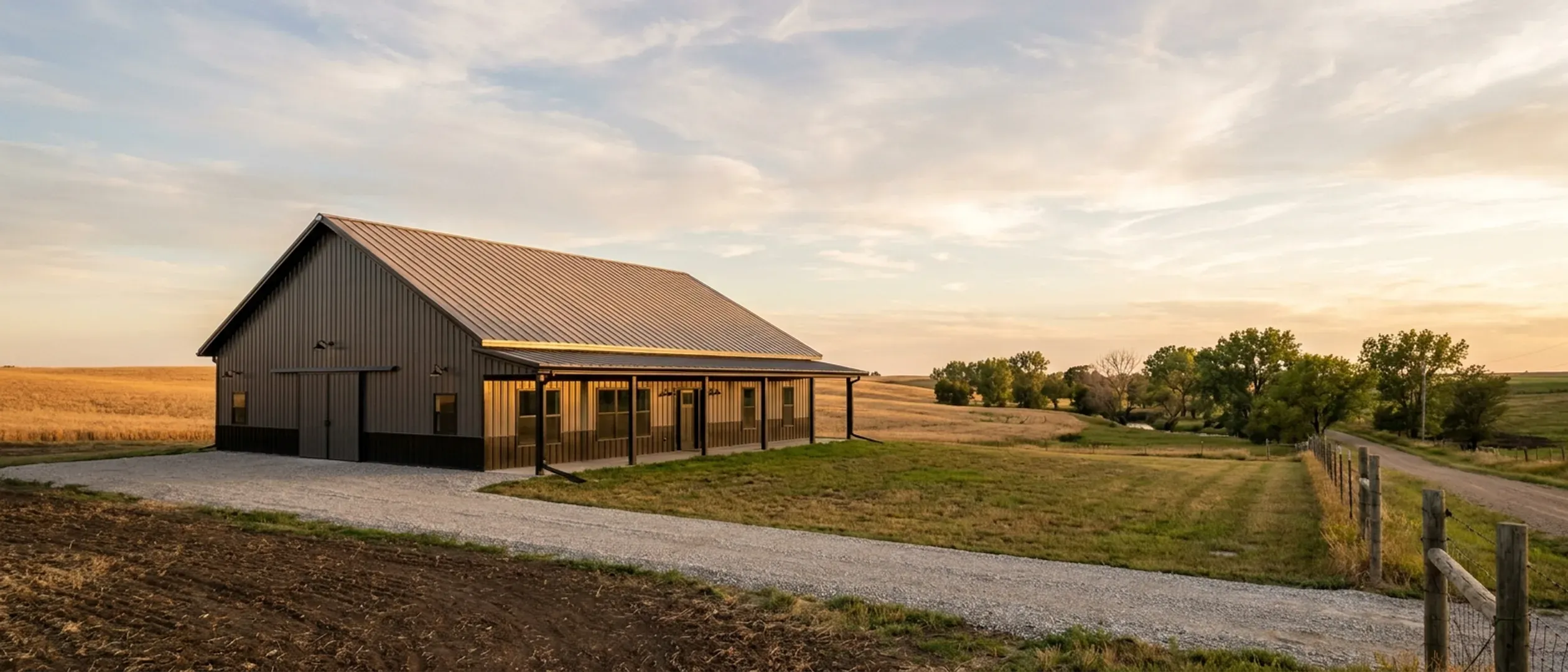
Barndominium Pros and Cons in Kansas: Wind, Hail, Soils, Local Codes and Appraisal
Pros-and-cons lists for barndominiums tend to be written for everywhere at once, which makes them true nowhere in particular. This one is written for Kansas. Some of the advantages are structural and hold anywhere: a clear-span shell, a shop and a house under one roof. Others depend on Kansas specifics, and several of the disadvantages are Kansas-shaped too: a spring storm season the National Weather Service measures in detail, homeowner policies that the State's insurance department says usually carry a separate wind and hail deductible, soils that the State's own septic bulletin says restrict conventional drain fields across much of eastern Kansas, and a code regime so local that the same building faces a full engineering review in one county and no building code at all in the next. Every claim below names its source; where the answer is it depends, the page says what it depends on.
Figures on this page are cited third-party or government data, not a quote from Kansas Barndominium Builders.
Bottom Line Up Front
- The real structural advantage is the clear-span shell: no interior bearing walls, a plan you can change later, and a shop and a house under one roof and one foundation.
- The Kansas-specific weaknesses are exposure and paperwork: spring tornado and hail season, a separate wind/hail deductible on most homeowner policies, septic soils, and building departments that may require sealed drawings for steel and post-frame homes.
- Appraisal and resale are the soft spot. There are fewer comparable sales for post-frame and steel homes on rural acreage, and a large shop may not add value in proportion to its cost.
Three different buildings, one word
Before any advantage or disadvantage means anything, be clear which of these you are actually considering. The differences are structural.
Post-frame (pole barn) construction
Laminated or solid wood posts set in the ground or on piers, with girts and purlins carrying metal wall and roof panels. Economical for wide clear spans. Johnson County treats it as a non-conventional design requiring an engineer-sealed plan in its unincorporated area.
Steel frame
Engineered steel columns and rafters on a concrete foundation, the frame and its engineering coming from the manufacturer. Johnson County lists steel framed construction among designs that must be designed and sealed by a licensed design professional.
Conventional framing with metal cladding
A stick-framed house finished with metal siding and roofing. It looks like a barndominium but is built and inspected like any other house, and gives up most of the clear-span advantage.
Where a barndominium genuinely wins
These hold in Kansas as elsewhere; the Kansas angle is noted where there is one.
Clear span and a flexible plan
With no interior bearing walls, rooms can be rearranged later without structural work.
One building instead of two
A shop and a house under one roof and one foundation, where you would otherwise build a house plus a detached shop. The saving is real only if you actually need the shop.
A permit application that recognises the type
Riley County's residential permit application lists Shouse (shop/house) as a building type next to stick-built and modular, so in at least some Kansas counties the form itself treats it as an ordinary dwelling choice.
Plans without an architect, where allowed
Kansas law exempts plans for buildings of no more than two dwelling units from architect and engineer licensing (K.S.A. 74-7031(b), 74-7033(b)), which keeps design flexible where the local department does not require a seal.
Where it is weaker, and what to do about it
Each of these is manageable, but only if it is designed for rather than discovered.
Condensation behind a metal skin
Through a Kansas heating season, warm interior air meeting cold steel condenses unless insulation, vapour control, air sealing and ventilation are designed together. This is the most common complaint about metal-clad homes, and it is a design problem, not an inevitability.
Storm exposure during and after construction
A partly sheeted shell in April to June, the months the National Weather Service identifies as the Kansas tornado peak, is vulnerable. After completion, connection details and panel fastening decide performance in the weaker tornado ratings that make up most Kansas events.
Hail and the insurance conversation
Get the insurer's position on metal roofs, cosmetic damage and the wind/hail deductible before the roof is chosen, not after the first storm.
Septic limits on rural parcels
Where soils restrict a conventional field, an alternative system or lagoon may be needed, subject to the county sanitary code or, where there is none, KDHE's Bulletin 4-2 standards.
Heavier paperwork in some counties
Sealed drawings for steel and post-frame homes, as in unincorporated Johnson County, add design time and cost before the permit can issue.
The value question
The softest part of the case, and the one most lists skip.
Few comparable sales
An appraiser values a house on sales of comparable property. In rural Kansas there may be few recent sales of post-frame or steel homes nearby, which makes the appraisal less predictable than for a conventional house on a subdivision lot.
A shop is valued as a shop
A large insulated shop can cost a great deal to build and still be valued closer to an outbuilding than to living area. Build it because you need it.
An inspection record helps later
Where the county inspects, the record exists. Where it does not, keep sealed drawings, manufacturer engineering, septic permits and construction photographs to show a future lender or buyer.
Reading this because you are weighing a build? The next step is a plan drawn for your program.
What's different about Kansas
Tornadoes: frequent in Kansas, and mostly weak
The National Weather Service office in Wichita reports that Kansas averaged 81 tornadoes a year from 1994 to 2023, that over 90 percent of Kansas tornadoes since 1950 have been rated F/EF0 to 2, with around 5 percent strong to violent (F/EF3 to 5), and that April through June accounts for about 74 percent of the annual total. Across 1950 to 2023 its county counts run from 11 in Wyandotte County to 113 in Ford County. For a building decision that is the useful part: most tornadoes that reach a house are the weaker ratings, where the anchorage of posts or columns, the roof-to-wall connections and the fastening of the panels decide what stays on. No ordinary house of any kind is designed to survive a direct hit from the strongest tornadoes; a storm shelter or safe room is a separate decision.
Wind and snow figures come from your county, not the State
Kansas adopts no statewide residential code, so there is no statewide design wind speed or snow load. Where a jurisdiction sets them, they are its figures: unincorporated Johnson County, for example, requires post-frame homes to be designed to the 2018 International Building Code for a 115 mph wind load at exposure C and a 20 psf roof snow load, with engineer-sealed drawings. A kit manufacturer should design to the figures your building department uses, and, where no department sets any, you should ask what figures the frame was designed for and get them in writing.
Hail, insurance and the separate deductible
The Kansas Insurance Department's home and renters shopper's guide says most homeowner policies have a separate wind/hail deductible that is generally one to two percent of the amount of insurance carried on the structure, while other perils usually carry a dollar deductible. It also says insurers' underwriting guidelines are not filed with the department, and lists a fire-retardant roof among possible discounts. For a metal-roofed barndominium the questions to ask an agent before you build are how the insurer treats cosmetic hail denting on a metal roof, whether the policy settles the roof at replacement cost or actual cash value, and what the wind/hail deductible is in dollars on your coverage amount.
Soils and septic in eastern Kansas
KDHE Bulletin 4-2 notes that many soils, especially in eastern Kansas, have properties that restrict their suitability for soil absorption fields, and that lagoons or alternative treatment systems may be used to compensate. That is not a barndominium problem, but barndominiums are mostly built on rural parcels without sewer, so it lands on them. It also affects the shop: a working shop floor drain needs its own plan, because shop wastewater is not household sewage.
Local codes cut both ways
Riley County requires a building permit but has adopted no building code; unincorporated Johnson County inspects to the 2018 International Codes and requires sealed drawings for steel and post-frame homes. In the first, a barndominium avoids plan review but also avoids any independent check of the structure. In the second, the paperwork is heavier but the finished house carries an inspection record a lender or later buyer can see.
Agricultural land is taxed on use, not market value
The Department of Revenue's Property Valuation Division states that agricultural land in Kansas is appraised on its productive potential, not fair market value. A barndominium is often built on land currently valued this way, which can make the tax records a poor guide to what the house and homesite will appraise for when a lender or buyer looks at it.
Pros and cons, honestly
Pros
- Clear spans and no interior bearing walls: the floor plan is not fixed by structure and can be changed later.
- A shop and a house on one foundation and under one roof, when you genuinely need both.
- A manufacturer's kit arrives with its own engineering, and the shell goes up quickly.
- Kansas licensure law does not require an architect or engineer for plans of a building with no more than two dwelling units.
- Some Kansas counties' permit forms already list the shop/house as an ordinary dwelling type.
Cons
- Condensation behind a metal skin through a Kansas heating season, unless insulation, vapour control, air sealing and ventilation are designed together.
- Spring tornado and hail exposure, with a separate wind/hail deductible on most homeowner policies according to the Kansas Insurance Department.
- Eastern Kansas soils often limit conventional septic fields (KDHE Bulletin 4-2).
- Some building departments require engineer-sealed drawings for steel and post-frame homes.
- Fewer comparable sales for appraisal, and a large shop may not add value in proportion to its cost.
- Where no building code is adopted, no inspector checks the structure.
Are barndominiums safe in Kansas tornadoes?
How do metal roofs do with Kansas hail?
What is a wind/hail deductible?
Is there a Kansas wind or snow load requirement for barndominiums?
Do barndominiums have condensation problems?
Are barndominiums harder to appraise in Kansas?
Is a barndominium cheaper to insure?
Does the building type change the septic requirements?
Questions answered? Tell us what you want to build and we will put real numbers against it.
Sources
- National Weather Service, Wichita — Kansas tornado climatology and statistics
- Kansas Insurance Department — Home and Renters Shopper's Guide
- Johnson County — new single-family dwellings permit requirements (post-frame and steel)
- Riley County Building Division — permits, no adopted building code
- Riley County — application for permit to build, residential dwelling, modular or shouse
- KDHE Bulletin 4-2 — minimum standards for onsite wastewater systems
- Kansas Corporation Commission — Kansas building energy codes (home rule statement)
- K.S.A. 74-7031 — architecture exemptions (two dwelling units)
- K.S.A. 74-7033 — engineering exemptions
- Kansas Department of Revenue — agricultural land value questions
Keep reading
The pages that answer the next question this one raises.
Are barndominiums worth it?
The decision page: land, appraisal, resale and the shop-plus-house case in Kansas.
Read itAre barndominiums legal in Kansas?
Local codes, the agricultural exemption and septic rules behind several points on this page.
Read itPost-frame homes
The pole-barn construction method, and what a building department may ask for.
Read itSteel construction
Steel-frame barndominiums and the manufacturer engineering that comes with them.
Read itBarndominium financing
How appraisal and comparable sales affect the loan.
Read itStart the survey
Tell us about your land and what you need the building to do.
Read itWant a real number instead of a range?
Start the survey and tell us about your land and what you want to build. Include the county and parcel ID if you have them, because in Kansas the jurisdiction, the soil and the well and septic answers change the budget more than the building does. The survey costs nothing.