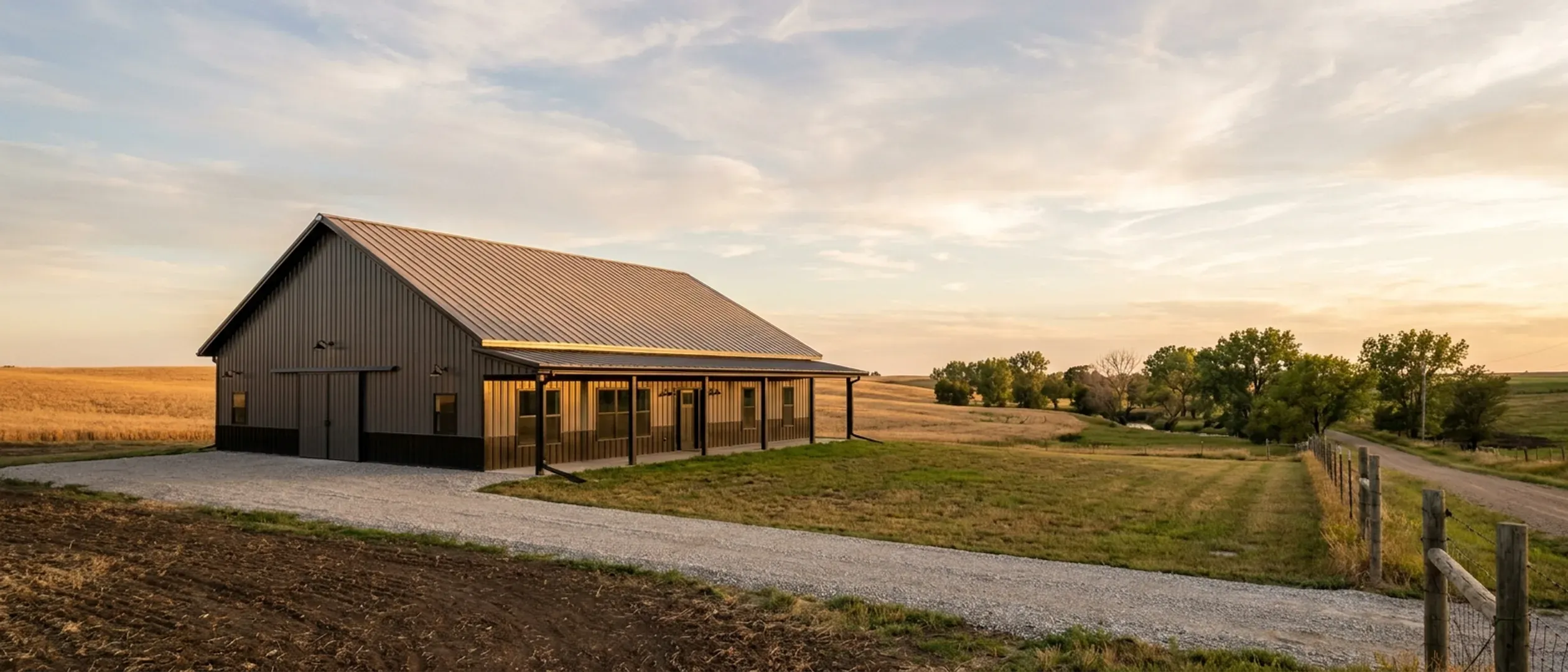
Are Barndominiums Worth It in Kansas? Land, Appraisal, Insurance and the Shop-Plus-House Case
Whether a barndominium is worth it is not a question about the building type in general. It is a question about your land, your use of the shop, how long you intend to stay, and how the house will look to a lender, an insurer and a future buyer. Kansas adds its own terms to each of those. Farmland prices differ several-fold between regions, according to Kansas State University's annual land values report. Most homeowner policies carry a separate wind and hail deductible, according to the Kansas Insurance Department. The rules that reach your parcel range from a full engineered-plan review to no building code at all. And the agricultural zoning exemption, which some buyers count on, applies to a house only on specific facts. This page sets out where the answer is clearly yes, where it is clearly no, and what to check in between. It does not quote build prices; the cost guide covers published third-party figures.
Figures on this page are cited third-party or government data, not a quote from Kansas Barndominium Builders.
Bottom Line Up Front
- Worth it when you genuinely need shop, equipment or storage space you would otherwise build separately, and you intend to stay long enough that resale variability stops mattering.
- Less clearly worth it on a short horizon, when the budget relies on the maximum loan, or when the plan depends on an agricultural exemption the county may not grant for a house.
- Land sets much of the answer. K-State's 2025 report puts average non-irrigated cropland sales at $1,928 an acre in the Southwest region and $7,363 in the Northeast, and small residential tracts trade in a different market from farm sales.
Where the answer is clearly yes
Each of these is a situation rather than a preference. If two or more describe you, a barndominium is very likely the right building.
You need a real shop, and would build one anyway
Equipment, vehicles, a trade, livestock gear or hobby space. Putting it under one roof with the house saves a second foundation, roof and envelope. If you would not otherwise build the shop, that saving does not exist.
You own or are buying suitable rural land
Zoned for a dwelling, with road access, a septic site that passes the county's test and a reachable water supply. Without these, the building type is not the question yet.
You plan to stay
The weaker points of the case, appraisal variability and a smaller pool of buyers, matter most at resale. A long horizon makes them matter less.
You want a flexible plan
Clear-span framing lets the interior change as the household does, without structural work.
Where the answer is probably no
None of these makes a barndominium impossible. Each makes it harder to justify.
A short ownership horizon
Few comparable sales in rural Kansas mean a less predictable appraisal and a narrower market when you sell.
A subdivision lot with covenants
Recorded restrictions can bar metal siding or post-frame construction outright. Riley County's permit application asks applicants to check for homeowner association and covenant restrictions for this reason.
A plan that depends on the agricultural exemption
Counties grant it on evidence. Douglas County, for instance, asks for Schedule F farm income and at least three acres in agricultural use, and defines an agricultural building as one that is not a place of human habitation. If your land is not genuinely farmed, plan the house as a house.
No room in the budget for the site
Septic, well, drive, power and pad come on top of the building. Where eastern Kansas soils limit a conventional septic field, as KDHE's Bulletin 4-2 says many do, an alternative system adds more.
The value checks to run before you commit
Five questions whose answers decide most of the case.
What will it appraise for?
Ask a lender and a local appraiser whether there are comparable post-frame or steel home sales nearby, and how they would treat the shop area.
What will it cost to insure?
Get a quote on the actual building, with the wind/hail deductible stated in dollars, and ask how the insurer treats hail on a metal roof.
Which rules reach the parcel?
Building code or none, sealed drawings or not, the septic authority, and any covenants. Each changes cost and time.
Will the site work?
A soil evaluation for septic, a water source, a legal entrance and a 911 address. Johnson County, for example, will not issue a permit without an address.
Can you document the build?
Manufacturer engineering, any sealed drawings, septic permit and final, and construction photographs. A future buyer's lender may ask for them, especially where no county inspection took place.
Reading this because you are weighing a build? The next step is a plan drawn for your program.
What's different about Kansas
Land values differ several-fold across Kansas
Kansas State University's Kansas Agricultural Land Values and Trends 2025 reports average non-irrigated cropland sales of $1,928 per acre in the Southwest region and $7,363 in the Northeast, with Leavenworth County at $9,384. In the East Central region it reports pasture and hay ground from $6,901 per acre in Miami County down to $2,804 in Chase County, and says Johnson County values could not be reported at all because agricultural use could not be separated from urban development. These are agricultural sales. A five- or ten-acre homesite with road frontage is a different market, and near Kansas City, Lawrence or Wichita it is shaped by development demand rather than farm income.
Land prices have stopped climbing fast
The same K-State report cites National Agricultural Statistics Service figures showing Kansas land values rose 22.8 percent in 2022, 13.6 percent in 2023, 8.0 percent in 2024 and 4.4 percent in 2025, and says increases in 2026 may be close to zero. It also notes that hunting, oil and gas exploration and wind turbine development move local land markets. Buying land as part of the case for a barndominium is a long-horizon decision, not a short-term gain.
The tax value of farmland is not its market value
The Department of Revenue's Property Valuation Division states that agricultural land in Kansas is appraised on its productive potential, not fair market value. That is good for the farmer's tax bill and misleading for a buyer: the county's number on a parcel of cropland says little about what the house and homesite will appraise for when a lender looks at them.
Insurance: the separate wind/hail deductible
The Kansas Insurance Department's shopper's guide says most homeowner policies have a separate wind/hail deductible that is generally one to two percent of the amount of insurance on the structure. On a large building with a big shop under the same roof, the insured amount, and so that percentage deductible, is larger than for a house alone. Price the policy, and the deductible in dollars, before you settle the size of the building.
Storm exposure is real but mostly moderate
The National Weather Service in Wichita reports that Kansas averaged 81 tornadoes a year from 1994 to 2023 and that over 90 percent of Kansas tornadoes since 1950 were rated F/EF0 to 2. For value, what matters is that the building is designed and fastened for the wind figures your county uses, and that you can show it was.
The rules follow the house to your parcel
Kansas leaves building codes to cities and counties. That can make a barndominium quicker to start in a county with no code, and harder to finance or sell later if there is no inspection record. It also means an agricultural exemption is a fact question for a house: the Kansas Supreme Court applied it to a farmer's own home on a working 40-acre farm in Blauvelt (1980) and expressly declined to decide anything wider.
Pros and cons, honestly
Pros
- The shop-plus-house consolidation is a genuine saving, one foundation, one roof and one envelope instead of two, when you need the shop.
- Clear spans make the plan adaptable for the long term.
- Rural Kansas land outside the metro areas is priced far below the Northeast region on K-State's 2025 figures, which can leave more of the budget for the building.
- Kansas licensure law lets plans for a one- or two-family home be prepared without an architect or engineer, where the local department does not require a seal.
- A household well needs no water-appropriation permit (K.S.A. 82a-705).
Cons
- Appraisals are less predictable in rural Kansas where post-frame and steel home sales are few, and a large shop may be valued as an outbuilding.
- A percentage wind/hail deductible grows with the insured amount, and the shop is part of that amount.
- Land price growth has slowed sharply according to K-State's 2025 report, so land is not a quick appreciation play.
- An agricultural exemption for a house is fact-specific and cannot be assumed.
- Septic soils in much of eastern Kansas add cost on rural parcels.
- Where no building code applies, there is no inspection record to show a future buyer unless you keep one.
Are barndominiums worth it in Kansas?
Do barndominiums hold their value in Kansas?
How much is land for a barndominium in Kansas?
Will a barndominium cost more to insure in Kansas?
Can I avoid county zoning by building on farmland?
Is a barndominium a good investment compared with a conventional house?
Does a county with no building code make a barndominium a better deal?
What should I check before buying land for a barndominium?
Questions answered? Tell us what you want to build and we will put real numbers against it.
Sources
- Kansas State University — Kansas Agricultural Land Values and Trends 2025
- Kansas Department of Revenue — agricultural land value questions
- Kansas Insurance Department — Home and Renters Shopper's Guide
- National Weather Service, Wichita — Kansas tornado climatology and statistics
- Blauvelt v. Board of County Commissioners of Leavenworth County, 227 Kan. 110 (1980) — opinion text (Caselaw Access Project)
- Kansas Attorney General Opinion 2018-4 — agricultural exemption, dwellings and acreage
- Douglas County — agricultural exemption packet and affidavit
- Riley County — application for permit to build, residential dwelling, modular or shouse
- Johnson County — new single-family dwellings permit requirements
- KDHE Bulletin 4-2 — minimum standards for onsite wastewater systems
- K.S.A. 82a-705 — water appropriation other than domestic use
- K.S.A. 74-7031 — architecture exemptions (two dwelling units)
Keep reading
The pages that answer the next question this one raises.
Barndominium pros and cons
The structural comparison behind this page: tornadoes, hail, soils and local codes in Kansas.
Read itBarndominium cost
Published third-party cost figures and what drives them.
Read itBarndominium financing
Construction loans and how appraisal affects them.
Read itAre barndominiums legal in Kansas?
The agricultural exemption, local codes, septic and covenants in detail.
Read itShouses
Shop-plus-house designs, the strongest version of the case on this page.
Read itStart the survey
Tell us about your land and plans, and we will help you judge whether a barndominium fits.
Read itWant a real number instead of a range?
Start the survey and tell us about your land and what you want to build. Include the county and parcel ID if you have them, because in Kansas the jurisdiction, the soil and the well and septic answers change the budget more than the building does. The survey costs nothing.